
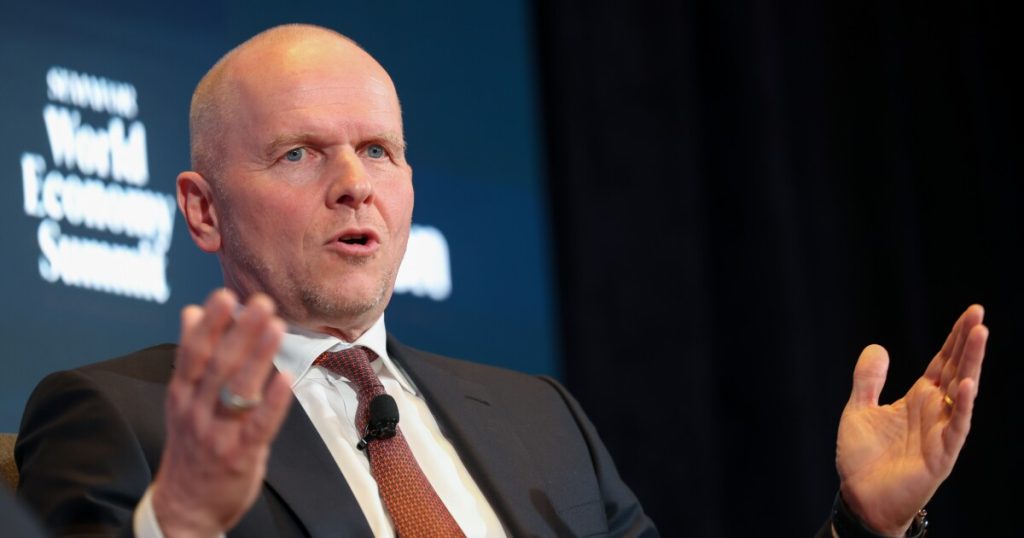
- Key insights: Mastercard’s earnings beat Wall Street analyst expectations.
- What’s at stake: Like other payment companies, Mastercard is monitoring the impact of the Iran war, and has noted declines in cross-border travel payments.
- Forward look: The card network slightly bumped its outlook for 2026.
Much like
Processing Content
“The geopolitical backdrop remains uncertain and has put some pressure on cross-border travel,” Mastercard CEO Michael Miebach said during Thursday’s earnings call.
The war has already disrupted travel and energy trading, causing
Within 24 hours of the conflict’s start, Mastercard launched a site for customers in the Middle East to see where spending is shifting due to the conflict, Miebach said.
“Our customers are coming to us and asking where is spending going in the Middle East,” Miebach said.
Muted impact, so far
Mastercard’s cross-border travel volume grew 2% in April through April 28th from the prior year’s April. That’s down from the first quarter of 2026, when volume grew 8% compared to the first quarter of 2025. Cross-border payments volume grew 9% for the month through April 28th, compared to 13% in the first quarter.
But the card network also reported that despite geopolitical risks, overall global spending remains strong, with pressure on “cross-border metrics” due to travel restrictions near the war zone and a reduction in the world’s energy supply. “It has also given us pause to worry about the safety of our team members, and we hope the war ends soon,” Miebach said. The card network said its “diversified” business model reduces concentration risk, and the war has not significantly dented Mastercard’s positive outlook for 2026 across its entire business.
During Thursday’s call, Mastercard projected a full-year revenue increase of just below 15%, which is slightly higher than its previous outlook. That is partly based on the war ending during the second quarter, with most of the impact from the war coming during that time and economic recovery in the third and fourth quarter.
“The April trends show a slight decline, and cross-border travel is meaningfully impacted,” RBC Capital Markets analysts said in a research note.
“Mastercard’s possible exposures (similar to Visa) are both positive and negative in that
Mastercard’s earnings and stablecoins
For the quarter ending March 31, Mastercard reported net revenue of $8.4 billion, up 12% from the prior year; net income of $3.9 billion, up 18%, and earnings per share of $4.60, up 18%. The Zacks Investment Research estimate was EPS of $4.40 and revenue of $8.29 billion.
Cross-border volume was up up 13% on a local currency basis compared to Q1 2025,
worldwide gross dollar volume was up 7% to $2.7 trillion, and U.S. GDV grew 4%. Value-added services and solutions net revenue increased 22%, or 18% on a currency-neutral basis.
Spending is “resilient, but a more cautious tone,” RBC said in its research note on Mastercard.
Mastercard made moves to improve its position in stablecoins and
BVNK, which was founded in 2021, specializes in technology that enables connections between traditional currency and digital currencies. Its technology covers blockchain networks in more than 130 countries. BVNK said it processes more than $30 billion annually and has clients that include fintechs, enterprises and payment service providers. BVNK will support stablecoin capabilities across Mastercard’s network, enabling stablecoin settlement for processors and acquirers; and adding stablecoin checkout to Mastercard’s payment gateway.
“
Mastercard plans to add BVNK to recent digital asset releases such as the
“BVNK positions us to drive interoperability in the digital asset world,” Miebach said.
Mastercard and Visa do not issue their own crypto or stablecoins, but have said they will support payments over their merchant networks. Much of this work involves making cryptocurrency easier to adopt for non-cryptocurrency users. Mastercard’s new crypto partner program includes firms such as Binance, BitGo, Circle, Crypto.com, Marqeta, MoonPay, Paxos and others.
BVNK will embed its tools in Mastercard’s network, which covers more than 200 countries and includes established relationships with banks, payment processors, fintechs, acquirers, and issuers.
Mastercard’s products include Mastercard Agent Pay, an agentic payments program, and Agentic Tokens, a security protocol that leans on Mastercard’s established tokenization capabilities to secure mobile contactless payments, secure card-on-file, and programmable payments such as recurring expenses and subscriptions.
Mastercard in March deployed a new AI model in partnership with Nvidia, which Miebach said can improve the ability to anticipate shifts on consumer behaviors.
“Volume is still at an early stage,” Miebach said, adding Mastercard would focus on technology that