
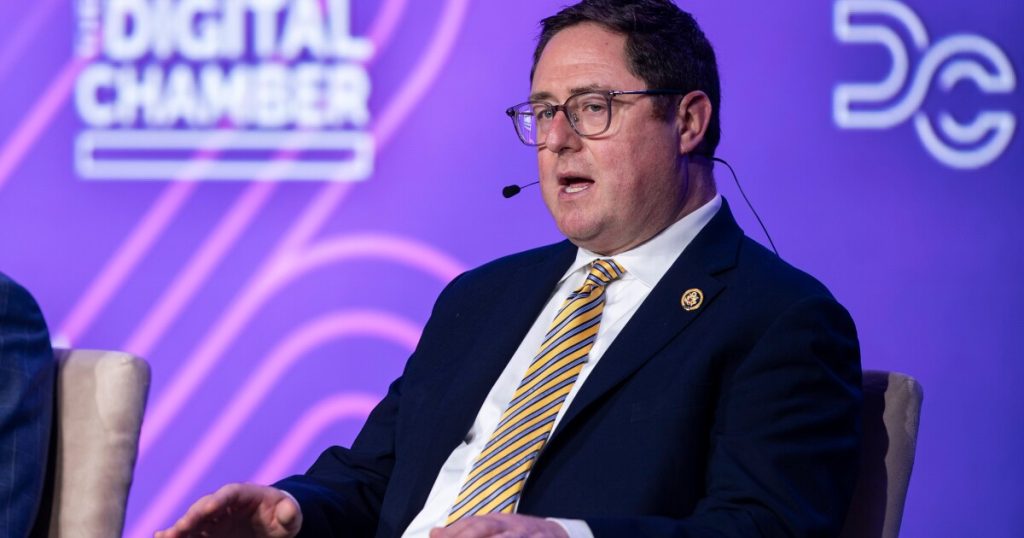
- Key insight: Bipartisan House bills that would limit largest banks from acquiring failed banks to counter industry concentration passed the House Financial Services Committee during a Tuesday markup session that carried on into Wednesday afternoon.
- What’s at stake: Rep. Mike Flood, R-Neb., offered a bill that allows the Federal Deposit Insurance Corp. to waive the least-cost resolution requirement if the requirements would increase bank consolidation.
- Expert quote: “There are situations where there is a compelling public policy case for the FDIC to choose an option that is not necessarily the least costly to the [Deposit Insurance Fund],” — Rep. Mike Flood, R-Neb.
WASHINGTON — Lawmakers on both sides of the aisle easily passed bills through the House Financial Services Committee that would tweak the Federal Deposit Insurance Corp.’s least-cost resolution requirement.
Processing Content
The bills still have a long way to go if they ever become law — they must be passed by the full House and Senate and be signed by President Donald Trump in a tight legislative calendar ahead of next year’s midterm elections. But the easy passage of the measures at the committee level is a strong signal that lawmakers are still willing to work together to address issues that were exposed with the failure of Silicon Valley Bank, Signature Bank and First Republic Bank in 2023.
After First Republic Bank failed in May 2023, JPMorgan Chase acquired a majority of the bank’s assets. This angered some lawmakers — notably Sen.
Now it’s a Republican Congress that’s taken up the issue. One bill authored by Rep. Mike Flood, R-Neb., would waive the least-cost resolution requirement, which requires the FDIC to select the bid for a failed bank that causes the least loss to the Deposit Insurance Fund in cases where the least-cost resolution would result in the biggest banks getting bigger. The measure passed the committee unanimously.
“The least cost resolution is often good and the best policy — we certainly want to protect the Deposit Insurance Fund when possible,” Flood said. “However, there are situations where there is a compelling public policy case for the FDIC to choose an option that is not necessarily the least costly to the DIF.”
Rep. Maxine Waters, D-Calif., the ranking member on the committee, supported this bill and others involving reform to the failed bank bidding process, but conditioned her support on the inclusion of provisions that prevent the largest too-big-to-fail institutions from “gaming the bidding process.”
“I consider this is the kind of effort that we can make to straighten out what the systems in the past have created — to uncreate them, to do away with them, and to do what makes good sense, particularly when you’re talking about stopping the concentration of big banks being able to acquire a failing bank,” Waters said. “Let banks who want to provide the services, who want to work with the community, who know the businessmen and women in their communities and what they need in the way of capital and who are prepared to help them out. This is good legislation and I’m happy to support this.”
Flood’s was not the only bipartisan measure to pass the panel without objection. The committee also passed a bill from Rep. Bill Huizenga, R-Mich., that would require the FDIC and Office of the Comptroller of the Currency to study modified bids or shelf charters in the failed bank bidding process, and another from Rep. Stephen Lynch, D-Mass., that would ban the use of some concentration limit exceptions — as was used in JPMorgan’s bid for First Republic for the 10% deposit cap — unless a banking agency determines that such a use is necessary.