
- Key insights: Banks are keenly aware of digital assets, and some are testing and building products; but most are just talking about the nascent technology.
- What’s at stake: Stablecoins could potentially revolutionize the infrastructure of banking, creating pressure on banks to have a plan.
- Forward look: As banks develop stablecoin strategies, they are also adding services related to digital assets and the underlying technology.
Processing Content
“You’ve heard me talk a lot about
But for all the talk from Fraser and other banking executives – and there is a lot of talk – most banks are doing very little with digital assets and the technology behind them, according to new research from American Banker.
The research details how the banks are adopting stablecoins, tokenized deposits and other services tied to distributed ledgers, or the technology that supports cryptocurrency. While some of the banks seem keenly aware of the potential, even eager in some cases, they also seem to be moving very cautiously.
The research comes as banks are expected to become more active in digital assets following the
“The key to the technology is its programmability, you can enable all sorts of things to happen,” Steve Marino, a senior manager at BNY, told American Banker. “People don’t have to worry about it being done, it’s happening in the background. You can use the tech to move assets at any time, regardless of where you are. A traditional system can’t do that.”
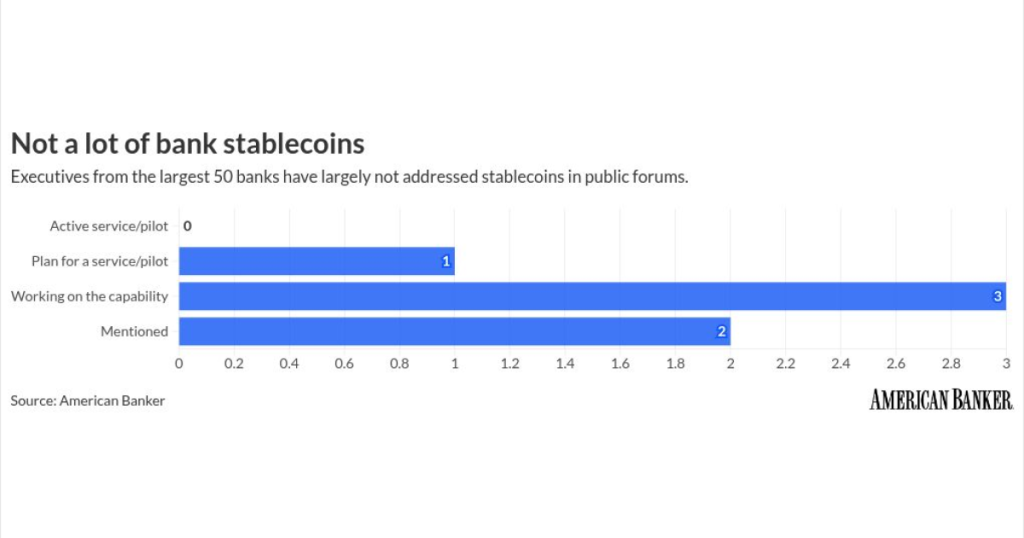
While none of these banks have issued their own stablecoins, the perception of an improving political environment has led banks to pay more
Banks are
What we did, and what we found
American Banker examined public documents and statements made by the largest 50 banks by assets under management as of the end of the third quarter of 2025. These statements, which were made during earnings calls, press releases and public presentations, covered distributed ledger-supported services.
Only 12% of the largest 50 banks have stablecoins “on their radar,” meaning they are piloting, planning or discussing stablecoin strategy, according to American Banker’s research. Eighteen percent are members of a stablecoin consortium, while 40% are members of a distributed ledger consortium. Fourteen percent of banks provide exchange services, while 22% are offering custody of public digital assets.
According to American Banker’s research, all of the
“I think we look at international transfers and then importantly, unrelated to kind of how it impacts PNC, I worry a lot about the dollarization of smaller countries because there is a real use case for individuals in foreign countries with volatile currencies who want to hold dollars to use stablecoin to do that,” William Demchak chairman & CEO of PNC Financial Services Group, said at Barclays Global Financial Services Conference in September.
PNC’s recent moves in digital assets include a December launch of
“We’re in the early innings of blockchain innovation, and crypto has a number of potential near-term catalysts on the regulatory front that should continue the positive momentum that we’ve seen to start the year,” Amanda Agati, chief investment officer for PNC’s Asset Management Group, told American Banker.
Despite the regulatory and market progress for stablecoins in 2025, more is needed, according to Agati.
“Crypto investors enter 2026 still waiting for [legislation detailing regulatory authority]. Will most crypto tokens be deemed securities, commodities or something else entirely? Layers of ambiguity remain, from legal jurisdiction and money transmission to definitions and enforcement.”
But despite their growth, U.S. dollar-back stablecoins may also struggle to meet the buzz, creating a potential need for alternatives.
Writing for
Beyond stablecoins, banks are more active in tokenized deposits. This is a claim on a deposit at a licensed depository institution, such as a bank, that is recorded on a distributed ledger. Tokenized deposits have been pitched to banks as a less risky alternative to stablecoins. Five of the largest 50 banks enable transactions via tokenized deposits, according to American Banker, while 12 banks support tokenized real-world assets, or traditional assets represented as tokens on distributed ledgers.
In an earlier interview, Kara Kennedy, global co-head of
“Blockchain can touch almost every part of the financial-services industry,” Kennedy said. “It opens the potential for speed, transparency and much greater programmability.”
What banks are doing
While
“It’s really important for us to ensure that our clients can leverage cutting-edge technologies and new developments and move their treasury management into the real-time world,” Ambrish Bansal,
Another active institution,
“Our mandate is to accelerate the products we offer around tokenized assets through partnership with our internal teams and clients, specifically focused on the interaction between digital assets and cash settlement,” Kennedy told American Banker.
“The focus moving forward is on joining the dots and evolving solutions that solve particular client pain points, adding value through new on-chain functionality,” Kennedy said.