
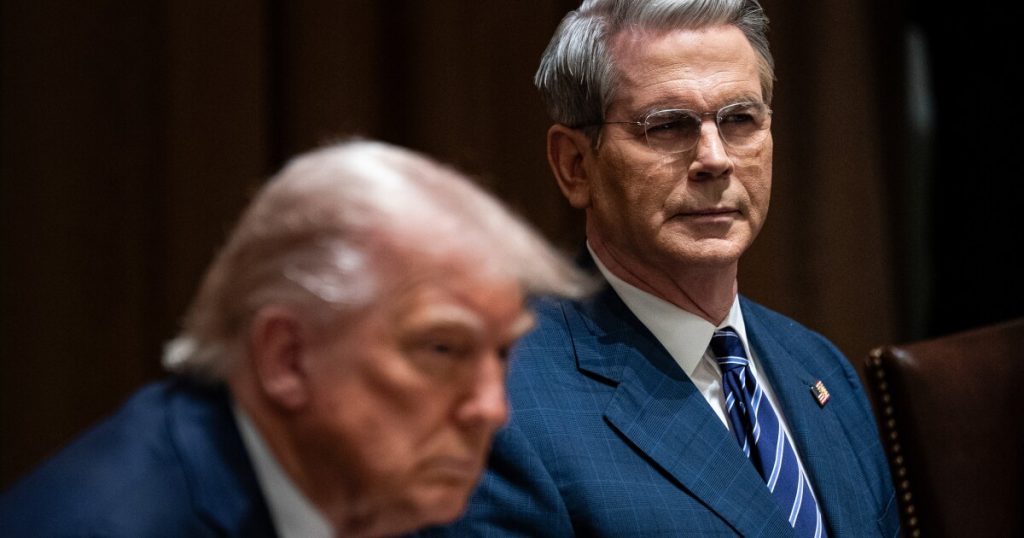
- Key insight: Treasury Secretary Scott Bessent avoided confronting the rate cap directly, but argued banks already are benefitting from deregulation elsewhere.
- Supporting data: Bessent argued that banks enjoy trillions in extra lending capacity, freed up by the unwinding of compliance standards.
- Forward look: The White House appears increasingly serious about passing a credit card interest rate cap despite banking industry pushback.
Treasury Secretary Scott Bessent on Tuesday assured banks the administration’s deregulatory efforts in a number of areas would counteract the business effects of President Trump’s proposed 10% cap on credit card interest rates, saying “bank stocks are at a new high” and that reduced compliance costs would expand firms’ lending capacity.
Processing Content
Speaking at a fireside chat at the World Economic Forum’s 2026 annual meeting at Davos, Switzerland on Tuesday, Bessent said he has and would continue to work with the bank regulators to bring down regulatory compliance costs, but did not back off from President Trump’s proposal.
“Through my position on [the] Financial Stability Oversight Council and the three bank regulators, the Federal Reserve, the [Office of the Comptroller of the Currency] and the [Federal Deposit Insurance Corp.], we have done a lot to deregulate banks — earnings are way up,” Bessent said. “There’s $2.5 trillion of extra lending capacity.”
Earlier this month, President Trump
In response, the Bank Policy Institute, the American Bankers Association, Consumer Bankers Association, Financial Services Forum and Independent Community Bankers of America issued a
“We share the President’s goal of helping Americans access more affordable credit,” the joint statement said. “Evidence shows that a 10% interest rate cap would reduce credit availability and be devastating for millions of American families and small business owners who rely on and value their credit cards, the very consumers this proposal intends to help. If enacted, this cap would only drive consumers toward less regulated, more costly alternatives.”
During the company’s quarterly earnings call Tuesday, U.S. Bancorp CEO Gunjan Kedia said the move could impact the vast majority of the firm’s clients, but noted the company also has low-interest offerings that could benefit borrowers with lower income or poorer credit.
“Our estimate is that 90-plus percent of our clients will see a detrimental impact if there was an across-the-board 10% rate cap on credit cards. The impact to 50% of the clients will be crushing, as it will be for the economy,” she said. “We have observed that just in the last few days, the conversation around the rate cap has shifted more productively to options for customers to help them in the short term. We think that’s a productive conversation.”
While President Trump’s proposal has rocked the financial industry, he has proposed similar measures in the past, most recently in the 2024 presidential campaign. The proposal has found the President with
But the idea also has bipartisan purchase among lawmakers in both parties, with Senators Bernie Sanders, I-Vt., and Josh Hawley, R-Mo., cosponsoring
In calling for banks to remember the topline benefits of deregulation, Bessent also displayed his focus on enabling smaller firms to flourish. Bessent underscored his focus on ensuring more community lenders can set-up shop and conduct business without burdensome regulation.
“What happened after the great financial crisis, all the regulations from Dodd-Frank, we had too big to fail, but then with small banks, you were too small to succeed,” Bessent said. “This regulatory morass, we have lost more than 50% of the small community banks; and they power small business lending, real estate lending and agricultural lending, so we are trying to bring that back.”