
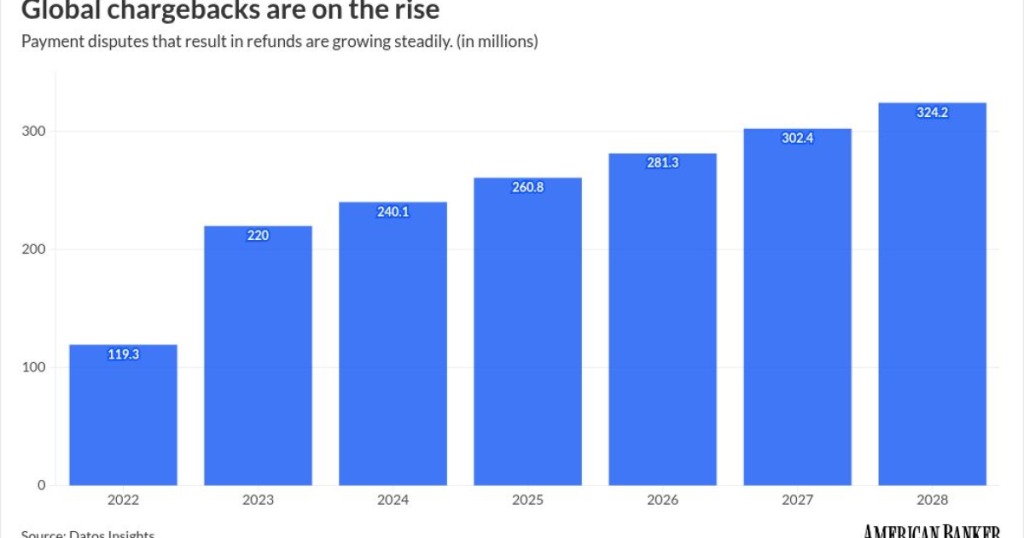
- Key insights: Chargebacks are on the risk and are on pace to reach 359 million in the next three years.
- What’s at stake: U.S. banks lose billions of dollars to chargebacks each year.
- Forward look: Advanced security techniques such as 3D Secure could ease the chargeback problem, according to payment analysts.
Card chargebacks are becoming a larger problem, with Datos Insights predicting an increase in global
Processing Content
This is bad news for banks, given that each dispute costs U.S. financial institutions $9.08 to $10.32 to process on average. Multiplied by an estimated 105 million chargebacks generated annually in 2026 in the United States, this represents billions of dollars of total expenditures across U.S financial institutions each year, according to Datos Insights.
What’s more, the average chargeback amount has increased nearly 16% to $251 between 2023 and 2025. The increase reflects broader shifts in transaction economics. “As prices rise, disputes tied to the same types of purchases naturally involve higher dollar values,” Josh Istas, head of product at TSG, wrote in an email to American Banker.
Additionally,
The trend is concerning for banks because higher-value disputes raise both financial exposure and operational costs. “At scale, dispute handling becomes a material expense. Just as importantly, dispute experiences shape customer trust. Institutions that invest in low-friction, transparent dispute workflows are better positioned to protect retention,” Istas wrote.
Here are five mistakes banks routinely make with chargebacks and how to avoid them:
Rubber-stamping disputes without scrutiny
“Banks too often side with cardholders reflexively,” Ron van Wezel, strategic advisor with Datos Insights, wrote in an email to American Banker. Financial institutions report 72% of chargebacks as fraud-related, while merchants attribute only 45% to fraud. “The reality is that merchants have a better view of first-party fraud because they can verify whether a supposedly fraudulent transaction was actually made by the legitimate cardholder — something banks simply can’t see,” he wrote.
Poor data capture at intake
Nearly all U.S. FIs rely on call centers for dispute intake, but call center agents are measured on speed, not thoroughness, van Wezel said. “The result: incomplete data gets handed to the back-office chargeback team, which then has to re-contact the cardholder — increasing costs and headcount,” he added.
Meanwhile, digital dispute portals are backfiring. Banks introduced online and mobile dispute filing to reduce call volume and costs. But it hasn’t been a time or cost-saver. “Digital dispute intake increases dispute volume by 30% to 40%, overwhelming back-office teams without delivering the cost savings call center management expected,” van Wezel wrote.
Falling behind on AI tools
Banks should increase their fraud protection defenses, taking advantage of the latest and most effective AI tools. “It’s a continual race against the fraudsters,” Tyler Kattre, president of Wind River Payments, a payments and merchant services provider, told American Banker.
Banks can monitor transactions and encourage their merchant partners to do the same. “If I’m a business in Wisconsin, why is someone in Ukraine trying to make a purchase?” Kattre said. Pattern analysis can help prevent disputes by stopping transactions before they occur.
AI tools are getting better at identifying and stopping fraudsters in their tracks, but the tools are widely underutilized. Only 25% to 30% of U.S. financial institutions use pre-dispute resolution tools like Ethoca Alerts, despite the fact that those who do rate them as effective or very effective, according to van Wezel of Datos Insights. “This is a significant missed opportunity,” he wrote. “Banks need to distinguish between legitimate fraud, first-party fraud, and nonfraud disputes at the point of intake — not after the fact.”
Banks also need to use AI better for predictive purposes. Visa Dispute Intelligence (VDI), for example, is an AI-powered feature within Visa Resolve Online that can be used to provide a “Probability of Success” score for disputes. The tool analyzes dispute characteristics to predict win likelihood. This helps merchants triage more effectively which cases to fight and which to accept.
Lax adoption of 3D Secure
North America has a chargeback-to-transaction ratio of 0.051%, versus Europe at 0.012% and Asia-Pacific at 0.007%, according to van Wezel. The primary driver is the absence of a U.S. mandate for strong customer authentication on e-commerce transactions. Asia-Pacific countries like Australia, Japan, and Singapore have adopted Strong Customer Authentication mandates and seen their fraud rates drop as a result. “This is a compelling policy argument for U.S. regulators — and a strategic case for U.S. banks to push merchants toward
Underestimating the competition advantage of differentiation
Dispute experience is increasingly emerging as a point of competitive differentiation for banks, according to TSG’s Istas. “Poorly designed dispute workflows can influence consumer switching decisions,” he wrote.
Kattre of Wind River Payments told American Banker that his bank has a robust mobile-based dispute-resolution process, but not every institution is ahead of the curve here. “If disputes increase, the gaps between the haves and the have-nots with their dispute processes are going to widen substantially, and that’s going to put a lot of pressure on the smaller issuers.”