
- Key insight: Rewriting existing mortgage contracts after the fact would introduce uncertainty into mortgage markets and is ill-advised.
- What’s at stake: Retroactive portability could also distort competition in housing markets.
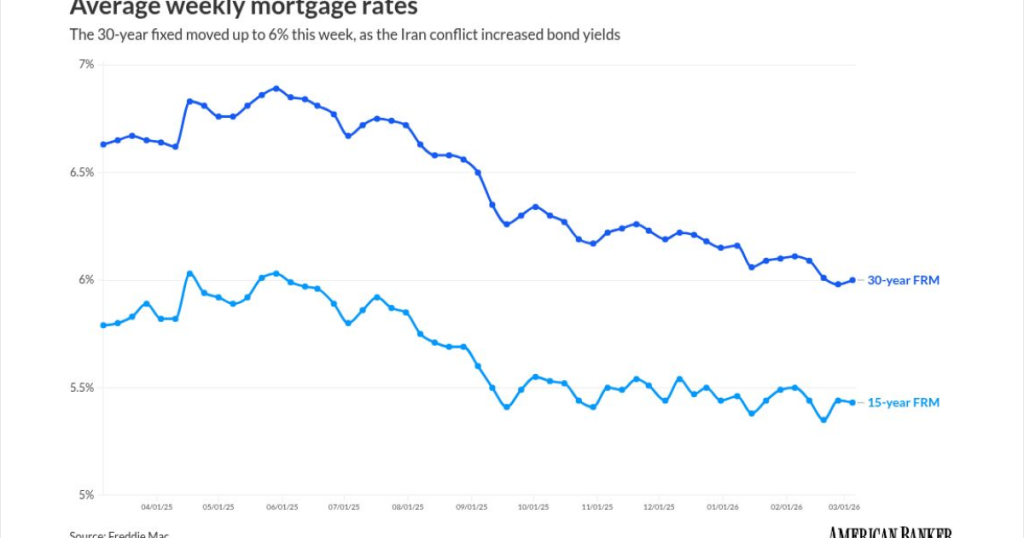
- Supporting data: More than 20 million households refinanced or purchased homes during 2020–2022. With mortgage rates now around 6%, many households feel locked into their current homes.
Millions of homeowners are reluctant to move because doing so would require giving up mortgage rates near 3% obtained during 2020–2022. With
Processing Content
Policymakers
Although portability is often discussed as a single concept, it can be structured in different ways — most notably as retroactive portability applied to existing mortgages or prospective portability offered on new loans. This article focuses on the risks associated with retroactive portability. Prospective portability raises separate and important policy questions that are beyond the scope of this article.
Currently, mortgage-backed securities are priced based on expectations about when loans will be repaid — through refinancing, home sales or defaults. In the recent low-rate environment, investors expected many loans to be repaid primarily through home sales, allowing reinvestment at higher interest rates as mortgage rates rose. Those expectations are embedded in the prepayment models used to price mortgage-backed securities.
Retroactive portability would reduce those expected cash flows and lower the value of outstanding mortgage-backed securities. In effect, interest income that investors expected to earn would instead be transferred to borrowers who retain their below-market mortgages.
Retroactive portability would grant borrowers a valuable option they never paid for, shifting the cost to mortgage investors. Borrowers who locked in historically low rates during 2020–2022 already benefit from below-market financing; retroactive portability would extend that advantage to future home purchases.
The effects would not be limited to pandemic-era loans. Borrowers with roughly 4% mortgages from the prior decade would also have an incentive to port rather than repay, further extending the lives of outstanding mortgage-backed securities. Investors holding those securities — including pension funds and 401(k)s — would bear those losses.
Those losses would be sunk and cannot be recovered through higher rates on new loans, since borrowers will only accept mortgages priced at prevailing market terms.
Retroactive portability could also introduce regulatory uncertainty. If investors believe the government may alter mortgage contracts retroactively in the future, they will price that risk into higher mortgage rates for future borrowers.
Finally, retroactive portability would face a high legal and policy bar. Existing mortgages are private contracts entered into under terms that neither borrowers nor investors expected to change.
Retroactive portability could also distort competition in housing markets. A household carrying a $300,000 mortgage at 3% that adds a $100,000 second lien at today’s roughly 7.5% rate would face a blended borrowing cost near 4% — well below the roughly 6% rate facing other buyers. That difference can translate into tens of thousands of dollars in additional purchasing power for the rate-advantaged borrower. Downsizers and lateral movers who retain their original low-rate loans would enjoy an even greater bidding advantage.
More than 20 million households refinanced or purchased homes during 2020–2022, and more than half hold loans backed by Fannie Mae or Freddie Mac. If even a modest share chose to port their mortgages, these rate-advantaged buyers — with a financing advantage of two to three percentage points — could reshape competition in housing markets nationwide.
The increased purchasing power of these borrowers could place upward pressure on home prices. Even accounting for the homes they leave behind — which add some supply — the net effect would likely be higher prices.
Because housing costs represent the largest component of the consumer price index, or CPI, policies that raise home prices can ripple through federal spending and tax systems. Higher CPI readings feed directly into Social Security cost-of-living adjustments and tax-bracket indexing, affecting federal spending and revenues. Elevated inflation would also complicate efforts to return inflation to the Federal Reserve’s 2% target.
Operational challenges also loom. The housing-finance system assumes each mortgage is tied to a specific property. Allowing loans to follow borrowers would require major changes to servicing contracts, lien rules and securitization structures.
Policymakers would also have to decide who qualifies. Would portability apply only to the more than 20 million borrowers who locked in the low “pandemic-era” mortgage rates, or also to more recent borrowers with mortgages closer to today’s market rates? And what about homeowners with pre-pandemic loans who are also effectively locked in by below-market rates?
Some analysts suggest portability could be structured to compensate investors through an upfront “portability fee” when borrowers transfer a low-rate mortgage to a new property. In theory, the fee would offset the longer life of the loan.
In practice, however, the economics are difficult to reconcile. If the fee fully compensates investors for the value of a below-market mortgage rate, borrowers would be financially indifferent between paying the fee and simply taking out a new loan. But if the fee is reduced to encourage mobility, the difference must ultimately be absorbed by mortgage investors.
Portability therefore presents a basic trade-off: It either fails to unlock housing mobility or quietly transfers value from investors to borrowers.
Retroactive portability raises significant design and market challenges. It would grant borrowers a valuable option they did not pay for, distort competition in housing markets, and impose losses on mortgage investors who priced loans under different assumptions.
Rewriting existing mortgage contracts after the fact would introduce uncertainty into mortgage markets and is ill-advised.