
American Banker’s 2026 AI Talent Shift Survey
American Banker’s 2026 AI Talent Shift survey was fielded online during March of 2026 among 206 banking professionals who occupy a variety of positions across banks, credit unions, neobanks and payments firms.
Top findings from the report
Results from the report are highlighted below using interactive charts. Mouse over each section for more detail, click on the chart labels to show or hide sections and use the arrows to cycle between chart views.
This item is the start of a series diving into new research from American Banker. Click the links below to read the other parts of the overall research.
Processing Content
The organizational significance of AI efforts
Key takeaway: At least half of bankers surveyed have AI usage as a high organizational priority.
The growing popularity and accessibility of AI-powered tools has executives eager to integrate new products in 2026.
More than half of respondents (66%) said AI usage is at least a high strategic priority for their organization, followed by 22% who said AI use is a moderate priority and 11% who said low priority.
Broken out at an institutional level, national bankers had the largest share of respondents (63%) who said AI usage was either the number one priority or among the top few within their organizations. Close behind were regional bankers (44%), community bankers (32%) and credit unions (23%)
Interestingly, credit unions had the largest share of respondents (44%) who said the use of AI technology was a moderate to low priority.
AI has continued to grow as a popular technology for strengthening, modernizing and advancing banking operations, touching virtually every aspect of banking from
Earlier this month, financial advisors at Bank of America’s Merrill Lynch and Private Bank units
Inez Louzonis, managing director of Merrill Lynch, told American Banker that workflows have “already changed significantly in the last six months” alone and that further change will come in “another six months, 12 months, 24 months, 36 months.”
“We need to deliver more effectively for our clients than ever before, and we also need to help them capture that wealth transfer,” Louzonis said. “We think that AI is a key enabler of that.”
What is the institutional ‘why’ behind AI?
Key takeaway: Productivity improvements and workflow automations are the top justifications for investing in AI.
Organizations are by and large turning to AI as a means for improving staff output, streamlining workflows and lowering operational costs.
Roughly 71% of bankers said improving the productivity of existing staff was the strategic goal behind their organization’s investments in AI, making it the top rationale. Close behind was automating key tasks or workflows (69%), reducing operational costs (60%) and protecting against fraud (48%).
Productivity improvement was almost the top justification across all respondent classes, coming in at 74% for national bankers, 65% for regional bankers and 73% for credit union leaders. Automating key tasks or workflows was the number one strategic rationale identified by 78% of community bankers, and tied with productivity improvement for the top spot among regional bankers and credit union executives. Of course, automating key tasks is a component of productivity improvement, so those two options are interwoven.
Institutions like
Raymond George, chief information officer at the Moon Township, Pennsylvania-based Clearview FCU, told American Banker his focus is to help employees not shy away from the realization that “AI is going to change or impact most everybody’s jobs” and work towards building competence.
“What we’ve been trying to do at Clearview is get people trained on the use of AI, how it’s to be used so we can start that changing of processes and job functions moving forward,” George said. “AI may not
The allure of increased productivity and other efficiencies can entice many institutions to adopt AI even if the technology isn’t a good fit, which
How did organizations change AI tech spend in 2025?
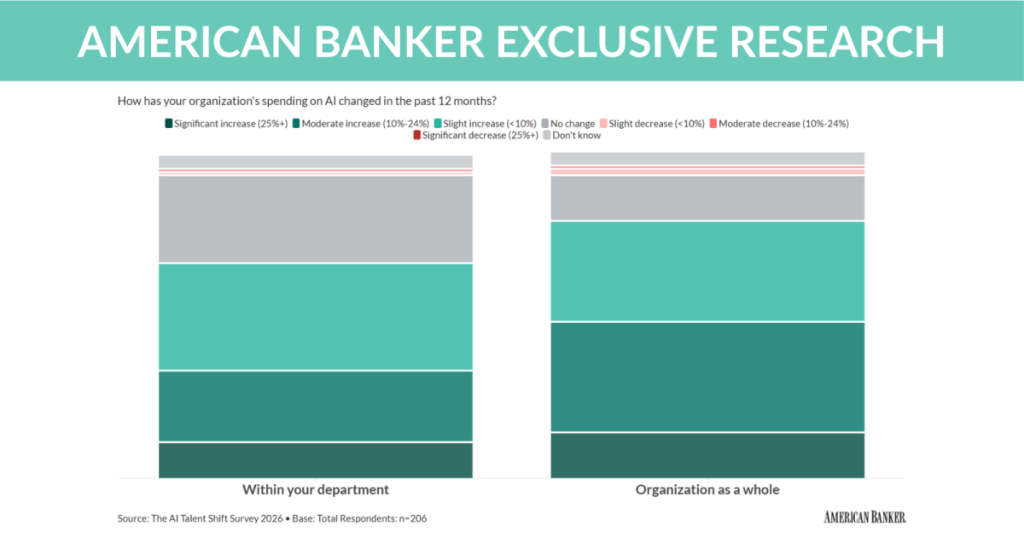
Key takeaway: A broad majority of institutions increased AI tech spend by at least 10% over the last 12 months.
Spending on AI was on the rise in 2025, and expectations are such that 2026 will be no different.
A majority of respondents said their organizations upped spending on AI by more than 10% both within their departments (66%) and across the company as a whole (79%) in the past 12 months.
National bankers (21%) reported the greatest spending increases of 25% and up, while regional bankers (35%) had the largest share of increases in the 10% to 24% range. Community bankers (28%) had the greatest share of respondents who said spending remained the same and credit unions (53%) reported the largest share of slightly increased spending of less than 10%.
Looking at the data broken out by department, increases significantly outweighed decreases: Wealth management/investment banking (74% vs. 8%); corporate/commercial (80% vs. 5%); retail/SBB (79% vs. 5%); compliance (77% vs. 5%); and payments (77% vs. 8%).
Banks and credit unions alike are betting big on AI as the technology becomes more widely accessible, aiming to overhaul legacy systems and develop modern product offerings.
“The technology is in a spot at the moment where it’s not hopes and dreams. … It’s here and present right now, and we’re leveraging it,” Coughlin said. “We’re going to invest about $300 million in incremental technology capital over three years, with the goal of having an exit run rate impact of $450 million in earnings value creation by Q4 2028.”