
- Key insight: First Interstate in Montana, which spent years growing through acquisitions, is taking a decidedly different approach under CEO Jim Reuter.
- What’s at stake: The bank’s balance sheet has already gotten smaller, as First Interstate closes branches and intentionally allows some loans to run off. The business will continue to shrink before it eventually gets larger, according to Reuter.
- Forward look: Some analysts are wondering if First Interstate is setting itself up to be an acquisition target. The bank remains focused on “disciplined organic growth,” its CEO said.
Plenty of banks are expanding their geographic footprints, either by opening branches in new or undertapped ZIP codes or by
Processing Content
First Interstate BancSystem in Billings, Montana, isn’t one of those banks.
After quadrupling its asset size over eight years, it is currently shrinking its branch network, running off certain transactional loans and refocusing its investments. It says the moves are in preparation for future organic growth.
The blueprint is the work of Jim Reuter, the former chief executive of FirstBank Holding Company in Colorado who joined First Interstate in late 2024, about eight months after he retired from his post at FirstBank. Reuter, 61, is a stalwart of relationship banking, or pulling in not only loans, but also deposits and service fees from the same clients, as a means to drive sustainable profitability.
Fifteen months into his tenure as Fifth Interstate’s CEO, the bank has accomplished a lot of the work, including the sale of a dozen branches in Arizona and Kansas, which put an end to the bank’s presence in both states. First Interstate is no longer originating indirect loans, including indirect auto loans, and it has outsourced its consumer credit card product.
In the fall, the $26.6 billion-asset bank
First Interstate BancSystem
“I like where we are today,” Reuter told American Banker this week. “I think 2026 is going to be a year where we get to see [benefits] because 2025 was a lot of recalibrating and refocusing.”
The change in strategy comes after years of a growth-through-acquisition mindset at First Interstate, which Wyoming cattle rancher Homer Scott purchased in 1968.
Between 2014 and 2022,
That $2 billion transaction brought First Interstate into eight new states, for a total of 14, and more than doubled the size of its branch network. Total assets grew to more than $32 billion.
Eventually, “the acquisition strategy kind of ran its course,” said Timothy Coffey, an analyst at Brean Capital. After
“It’s gone from growth mode to mature mode, I would say, and Jim’s leading that,” Coffey said.
One question that some analysts are pondering is whether First Interstate is positioning itself to sell, given the momentum that’s building in the regional bank mergers-and-acquisitions space.
This week, Spain’s Banco Santander, which operates a midsize banking subsidiary in the U.S., said it had
Cincinnati’s Fifth Third Bancorp
In a research note written after Santander’s acquisition plans were announced, Mike Mayo, an analyst at Wells Fargo Securities, included First Interstate on a list of 13 potential takeover targets, saying that the number of deals “should reach the highest in a decade.”
He acknowledged that the Scott family still owns a 10%-plus stake in First Interstate and that three family members sit on the 14-person board, which could be “a limiting factor.”
“It would not surprise me if they made that call,” Coffey said. “That’s the big ‘what’s next’ question.”
In response to a question about whether the bank is positioning itself to be sold, Reuter said Thursday by email that the bank remains “focused on executing our strategic plan — disciplined organic growth through full relationship banking.”
‘Now it’s about optimizing’
Reuter joined First Interstate after 37 years at FirstBank, which was
In January 2025, during his first earnings call as CEO, Reuter outlined the way forward: more relationship banking, fewer one-off loans, a focus on organic growth and the deployment of capital into markets where the bank could better compete.
The runoff of indirect lending, he warned at the time, would temporarily shrink the size of the loan book. And by mid-2025, the bank had signed a deal to outsource its consumer credit card product, a move that pushed some $74 million of affiliated loans off the bank’s balance sheet.
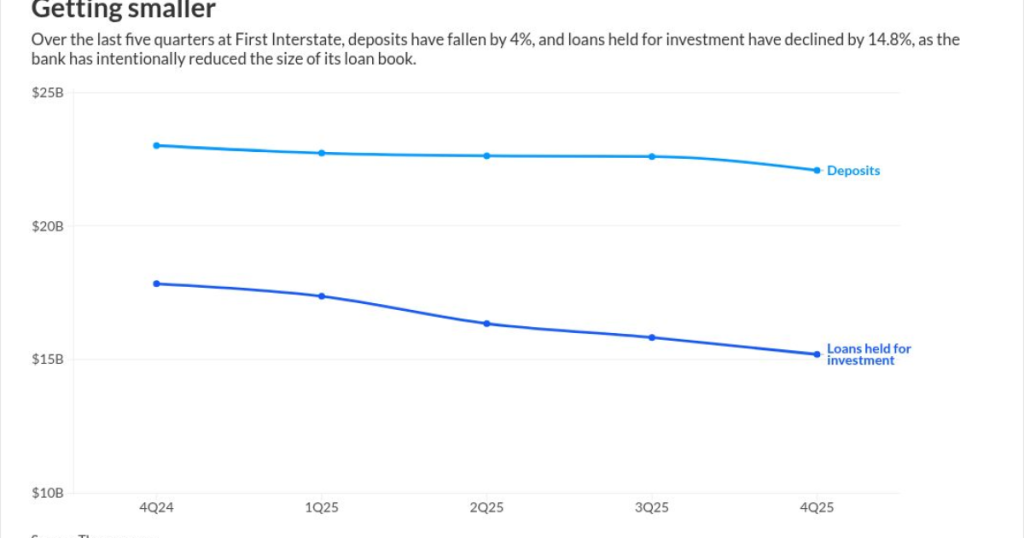
The transition hasn’t been without some discomfort. First Interstate’s loan portfolio shrank 14.8% from Dec. 31, 2024, to the same date a year later.
This year’s outlook for loan growth is “flat to slightly down,” excluding the ongoing runoff of indirect loans, which will result in a 1%-2% reduction in total loan balances, the bank said.
Deposits have also fallen as a result of branch closures. At the end of 2025, deposits were down by 4% compared with the prior year. They’re projected to rise by 1%-3% in 2026, excluding the impact of having fewer branches in Nebraska, according to the bank’s full-year guidance.
First Interstate announced in October that it had reached a deal to
In addition, the bank is closing four branches this month in eastern Nebraska. The moves will leave First Interstate with 29 branches in the Cornhusker State. It is also fully exiting Minnesota and North Dakota, with the pending closure of one branch in each state.
Post-realignment, First Interstate will have offices in 10 states. It’s opening new branches in Montana and relocating a branch in Wyoming, and it has hired a team of commercial bankers in Colorado. The bank may “look at some additional locations” in that state, “which continues to be an exciting opportunity,” Reuter said last week during the bank’s fourth-quarter earnings call.
One sore spot has been credit quality, specifically within the bank’s commercial real estate portfolio. Criticized loans totaled more than $1 billion at the end of the fourth quarter, up 36% year over year, though such loans were down nearly 10% compared with the third quarter.
Credit-quality issues “could slow the transition” for First Interstate, Coffey said. In a research note, he said that costs related to credit problems could have an adverse effect on earnings.
Reuter said the bank has been intentional about making sure it has a single approach to credit.
“We have good lenders and good credit folks, but when you’re built out of acquisitions, sometimes there’s a lagging effect of getting everybody on the same page,” he said.
The bank has retooled its loan committee so that “we’re all in the room together,” he said.
First Interstate has made progress in its quest to redefine itself as a relationship-based bank, Jared Shaw, an analyst at Barclays, told American Banker. Still, it takes time for client relationships to form, which means that it may take a while for actual growth to materialize, he said.
“To me, they’ve moved past the identification stage, and they’re into the execution stage,” Shaw said. “But it feels like, at least for 2026, it’s going to take that full year to reposition.”
“Organic growth is the goal, but right now it’s organic integration,” he added.
Reuter is optimistic about what lies ahead.
“I think the bank did a great job through that M&A time period of building out a good franchise,” he said. “And now it’s about optimizing the franchise that’s available.”