
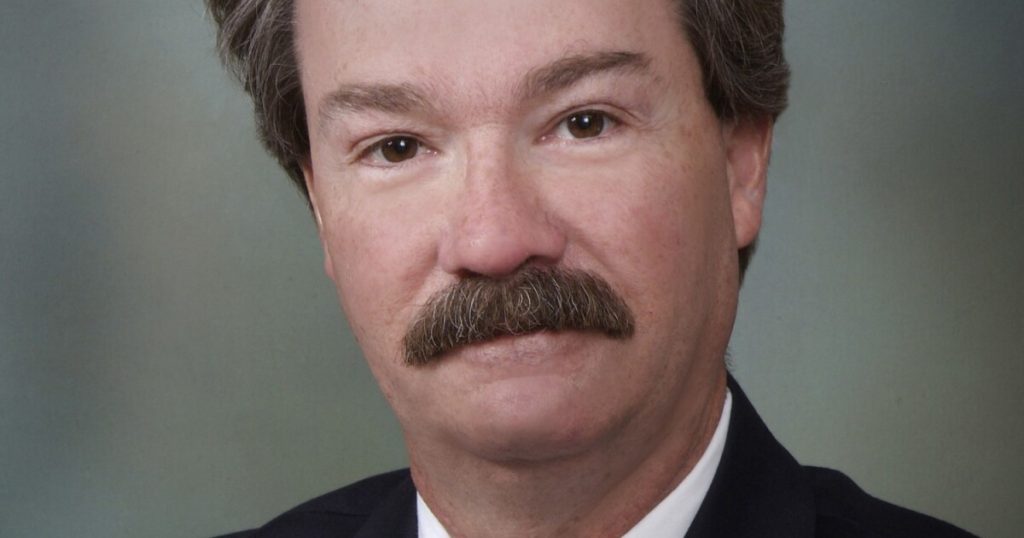
- Key insight: Joe Face is retiring after 28 years as commissioner of Virginia’s Bureau of Financial Institutions, the longest tenure in the job in the state’s history.
- Why it matters: A commitment to strengthening the dual bank regulatory system has been a hallmark of Face’s tenure.
- Expert quote: Face “has been at the forefront of establishing consistency and coordination among the states on financial supervision” — Conference of State Banking Supervisors President and CEO Brandon Milhorn.
Joe Face’s 46-year career with Virginia’s Bureau of Financial Institutions — including the past 28 as commissioner — nearly unraveled a day after he was hired.
Processing Content
Face, who earlier this month announced plans to retire at the end of January, recalled being assigned to join an audit team at a savings and loan in Suffolk. Under normal circumstances, the drive between Richmond, where the Bureau of Financial Institutions is based, and Suffolk takes about two hours. Face, however, was forced to contend with a tropical storm that left him both soaked and late.
“It rained the whole way down there,” Face told American Banker in an interview. “I thought I was going to be fired my first day. I thought, ‘I’m going to give this job six months and see what happens.'”
Face would stay and spend more than a decade crisscrossing the Old Dominion, examining banks, thrifts and credit unions. When he began his career in 1979, his equipage included a state-issued adding machine, a manual typewriter, carbon paper “and a satchel bank to carry my work in and lug that stuff all over the state.”
Face was promoted to deputy commissioner in 1993. He was elevated to commissioner four years later, succeeding Sidney Bailey, who had served 20 years and acted as a mentor to Face.
“Sid Bailey ran a very conservative operation,” Face said. “It was all about following the rules [and] making reasonable decisions. … Make good decisions and maintain integrity in everything you do. That’s what my predecessor did and what I tried to do as well.”
The formula has served Face well. Virginia has experienced just five bank failures during his nearly three decades leading the Bureau of Financial Institutions, the most recent one coming in 2014.
Face credited the boards and executives at Virginia banks for much of the state’s strong record. But Bruce Whitehurst, president and CEO of the Mid-Atlantic Bankers Association and the Virginia Bankers Association, said the quality and consistency of the state’s regulatory work has also been a factor.
“Virginia’s got a lot of things going for it,” Whitehurst told American Banker. “Great banking leadership, strong, diverse economy. But I think when you consider in the last nearly 50 years, we’ve had two banking commissioners, Joe for nearly 30 years and Sid Bailey for 20, that’s consequential. … I’d give Joe a little more credit than he gives himself.”
In a press release, Samuel Towell, chairman of the State Corporation Commission, which is the parent agency of the Bureau of Financial Institutions, said that Face’s “steady leadership over the last three decades has been of incalculable value to both consumers and the regulated community.”
Face has also been active on the national level, working for tighter coordination and cooperation among state banking agencies. He served as chairman of the Conference of State Banking Supervisors from 2006 to 2007. In the late 1980s, Face helped found the American Association of Residential Mortgage Regulators and served as the group’s first president.
Face “has been at the forefront of establishing consistency and coordination among the states on financial supervision,” according to Conference of State Banking Supervisors President and CEO Brandon Milhorn, who referred to the Virginia regulator as an “institution.”
“It’s not just about Virginia for Joe,” Milhorn told American Banker. “He wanted the entire state system to work well, to be effective, to be consistent, to be coordinated.”
In similar fashion, Charles Cooper, who has served as Texas’ banking commissioner since 2008, described Face as a consensus-builder who would go out of his way to assist colleagues in other state agencies.
“When I became commissioner, he helped me quite a bit…He was a great teacher,” Cooper told American Banker in an interview.
“You may think [the job of a state regulator] doesn’t involve being involved at the national level or working with other states, but that’s far from it,” Cooper said. “For us to be able to do our jobs, we have to be able to work together. That’s one of the things Joe strived for. To get commissioners to understand the importance of working nationally and working together.”
Born in Columbia, South Carolina, Face moved to Richmond at age 5 when his father took a job with the Bank of Virginia, which would become Signet Bank in 1986. Edward Joseph Face Sr. was a commercial banker who later helped launch Bank of Virginia’s correspondent banking business.
Despite his father’s occupation, Face’s move into a banking-related career was not a given. After graduating from the University of Alabama with a degree in business administration, Face returned home to Richmond to work a summer job, but he had every intention of relocating to Alabama, in no small part to be closer to his beloved Crimson Tide football team. Fate intervened when Junie Bradshaw, a judge on Virginia’s State Corporation Commission, recruited Face to join the Bureau of Financial Institutions.
Face had no hard-and-fast career plans when he started, so the idea of leaving the regulatory agency to take a job in banking “did cross my mind — but just in passing,” he said.
“I really enjoyed the regulatory work,” Face said. “I decided to hang in there.”
A commitment to maintaining a robust dual banking system, with state regulatory agencies working alongside their federal counterparts, has been one of the hallmarks of Face’s work as commissioner. As a key player in the Conference of State Banking Supervisors, Face played an instrumental role in the creation of the Nationwide Multi-State Licensing System for mortgage originators, which began operating in 2008.
“He’s always shown a willingness to engage and think differently,” Milhorn said. If you have that sense of service, if you have that willingness to grow and change, then a tenure like this can provide incredible stability for the system.”
“When I first went to a CSBS board meeting, all these guys had experience, Joe was one of the most senior people there,” Cooper said. “You could tell he had valuable experience, and he was afraid to try to share that experience with others…to try to improve the banking system and the state regulatory system.”
Face described himself as a “firm believer” in the dual banking system.
“I think it’s been great for the country. It’s great for the public,” Face said. “Sid Bailey used to say that one of the best things about the dual banking system is that it keeps regulators honest. I think there’s a lot of truth to that.”
Face’s last day is scheduled to be Jan. 30, ending his tenure as the longest-serving banking commissioner in Virginia history. In retirement, Face plans to spend more time with his granddaughters, golfing with friends and attending Crimson Tide football games, he said.
“I’m looking forward to not having a work calendar tell me where I need to be,” Face said.
Face said he has strong confidence in his successor, Dustin Physioc, who has served with the Bureau of Financial Institutions since 2006.
“He’s about the same age I was when I became commissioner,” Face said. “He’s going to do a fine job.”
“This is a big change for Virginia, for sure,” Whitehurst said.