
- Key insight: U.S. Bank is extending the maximum terms on its home-improvement loans to six or seven years, up from five years previously.
- What’s at stake: After a multi-year boom in the home-improvement market, affordability concerns are clouding the segment’s future prospects.
- Expert quote: “By extending loan terms for home improvement purchases, we’re helping merchants tackle affordability challenges head-on.” — U.S. Bank Head of Avvance and Point-of-Sale Lending Emily Hartye
At a time when affordability is a top concern for many American households, U.S. Bancorp is offering extended loan terms to home-improvement borrowers who might otherwise be unable to manage the monthly payments.
Processing Content
U.S. Bank’s $692.3 billion-asset parent company announced earlier this month that it would offer loan terms of six and seven years to borrowers engaged in larger home-improvement projects, up from five years before.
“By extending loan terms for home improvement purchases, we’re helping merchants tackle affordability challenges head-on, drive higher conversion, and deliver financing experiences customers can trust,” Emily Hartye, head of U.S. Bank Avvance and point-of-sale lending, said in a press release.
Echoing Hartye, other experts have said that growing affordability concerns could impact the home=renovation industry. Those worries were amplified when Home Depot, a leading source of supplies and materials for renovation jobs, reported a 3.8% decline in sales between November and January, compared with the same period a year earlier.
In January, the Pew Research Center
Though rising costs are creating a headwind, increased home equity as a result of house-price gains should provide homeowners with sufficient momentum to finance renovation projects, National Association of Home Builders Chief Economist Robert Dietz said in a speech last month.
“The surge in home equity has allowed more home owners to finance remodeling projects that meet their needs, which include growth for aging-in-place remodeling projects,” Dietz said on Feb. 17 at the International Builders Show in Orlando, Fla.
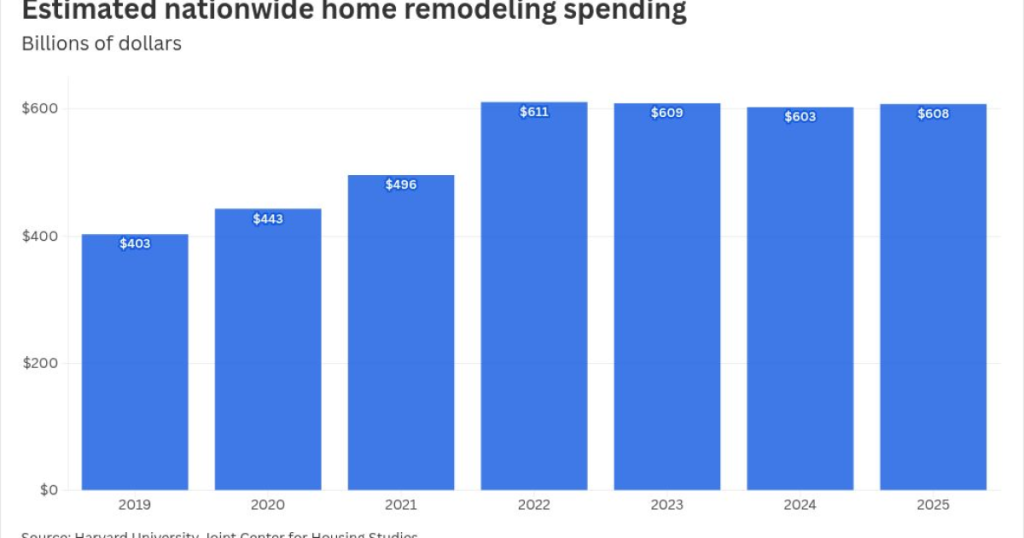
Home-improvement spending surged during the 2020-2021 COVID pandemic and has remained elevated since, presenting lenders with a lucrative niche opportunity.
In a recent
Minneapolis-based U.S. Bancorp launched its Avvance buy-now-pay-later platform, which offers loans for home improvements and other spending categories, in October 2023, amid the remodeling boom.
Loan durations for other verticals that Avvance serves, including audiology and elective medical procedures, remain capped at five years, according to a U.S. Bank spokesperson. Avvance is seeing “strong month-over-month volume growth and a growing merchant base,” she added.
U.S. Bancorp has hardly been alone in seeking to capitalize on the surge in home-improvement spending.
In 2021, Charlotte, N.C.-based Truist Financial spent $2 billion to
The following year, First National Bank of Omaha in Omaha, Neb., acquired Amerifirst, a home-improvement lender and servicer. FNBO rebranded AmeriFirst as Slice in 2024. It’s projecting 30% loan growth in 2026.
LendingClub in San Francisco made its own move in November,
In addition to rolling out longer loan terms, Avvance has also signed an agreement with Skeps, a UK-based fintech that connects lenders with contractors and through them with point-of-sale borrowers.
“Skeps’ book of business and platform reach, paired with U.S. Bank’s trusted lending and servicing capabilities, create a strong foundation for growth by broadening access to longer‑term payment options,” the U.S. Bank spokesperson said.
In a similar move announced in January, Hatch Bank in San Marcos, Calif., signed on as an embedded lender with Thrive, a financial technology platform that focuses on the remodeling industry. The $182.3 million-asset Hatch was already partnering with Wisetack, so the Thrive arrangement marked an expansion of its activity in the home-improvement space.