
- Key insight: Banks’ insistence on barring crypto firms from offering rewards on stablecoin holdings have stalled passage of a crypto market structure bill for months, but Senate Banking Committee Chair Tim Scott, R-S.C., suggested a breakthrough could arrive this week.
- Forward look: Without a compromise between the two industries, the bill faces a difficult path to passage in the House and Senate.
- What’s at stake: Bankers have expressed concern that yield-like rewards could drain deposits from the banking system, compromising banks’ ability to lend and fuel economic development.
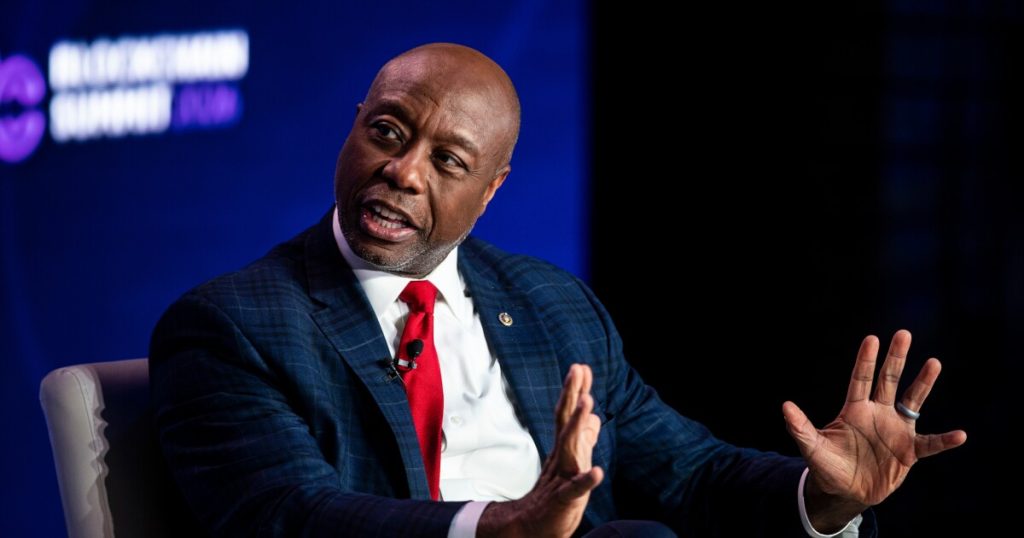
WASHINGTON — The Senate Banking Committee could have a compromise between banks and crypto firms as early as this week, the panel’s chairman Sen. Tim Scott, R-S.C., said at a crypto conference.
Processing Content
Talks on a crypto market structure bill have been derailed over disagreements between the crypto industry and the banking industry over yield-like rewards that the crypto industry wants to offer on stablecoins. Bankers say that the rewards are too similar to yield, and play into fears about stablecoins draining deposits from the banking system.
The GENIUS Act, the stablecoin law passed last year, does restrict stablecoin issuers from offering yield, but bank lobbyists want the prohibition to be more explicit and to cover all parties involved in stablecoin issuance, including crypto exchanges. The market structure bill is their best opportunity to enshrine such a ban.
“This is about having both sides at the table, fighting over the differences, and at the same time having all players — the industry and the financial services, the banks — at the same table,” Scott said at the Blockchain Summit in Washington Tuesday afternoon. “And I believe that this week we will have the first proposal in my hands to take a look at, and if that actually happened before the end of this week — and I think that it will — we’ll at least know what the sketch looks like in person. If that’s the case, I think we’re gonna be in much better shape.”
Without a compromise between the crypto industry and the banking industry, the bill might have a tough time moving through both the full Senate and the House, where House Financial Services Committee Rep. French Hill, R-Ark., has his own bipartisan version of market structure legislation.
Scott also referenced other controversial parts of the market structure legislation, such as ethics rules that Democratic lawmakers want to include related to President Trump’s own investments in crypto firms like
“I think we’re very close to landing the plane on the ethics issue, on quorum,” Scott said. “We know that that’s a big issue for our friends on the other side of the aisle, so we’re fixing that as well.”
However, those issues “seem to pale in comparison to the rewards issue,” Scott said.
Throughout the process, in which the White House has had to step in and encourage crypto companies and bank lobbyists to reach a compromise, bankers are still motivated to pass the legislation — risks to their deposit base notwithstanding — because of
A large portion of the bill would expand the definition of which activities banks are allowed to participate in to explicitly include digital assets. The bill’s authors say this is in response to the Biden administration’s attempt to keep risky crypto assets out of the banking system, but it could also open the doors for banks to engage in more activities that they could not engage in before.