
- Key insights: While AI is seen as a threat to jobs, there’s also opportunity, according to payment leaders who spoke at ETA’s Transact conference.
- Expert quote: “Feeling stuck is an opportunity,” said Naomi Mastera, business development manager at NMI.
- Forward look: Execs suggested teaching junior staff to use AI to take “deeper dives” into research.
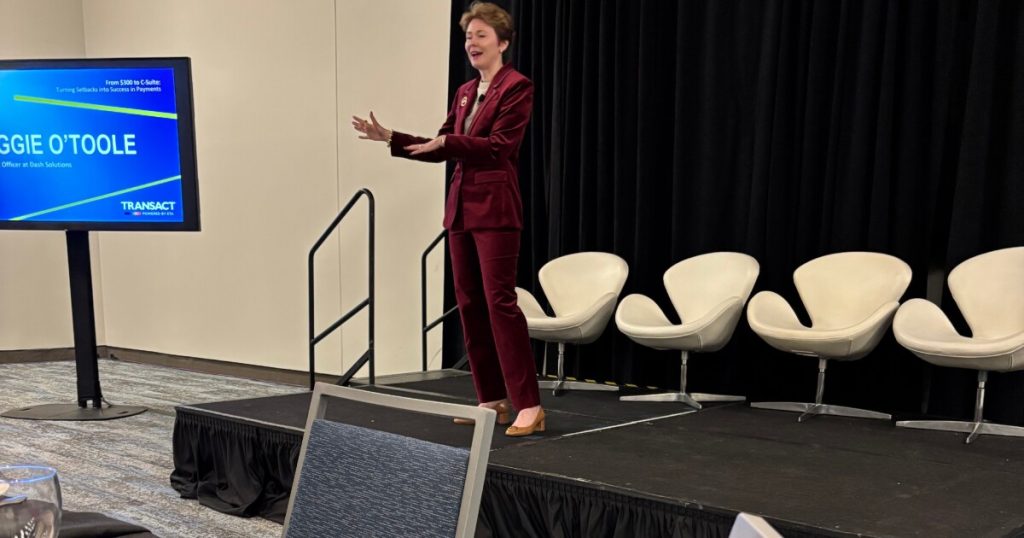
A career in payments was on the other side of the world for Maggie O’Toole, both literally and figuratively.
“At that time, women had very limited opportunities for careers and advancement,” O’Toole said of her childhood in Poland in the 1980s. “I knew I had to go somewhere.”
Processing Content
“Somewhere” was the U.S., where O’Toole has built a long and successful career in fintech. O’Toole, the chief client officer at payments fintech Dash, joined other women leaders in the payments industry at the Electronic Transactions Association Transact event in Atlanta on Thursday in discussing careers in an age dominated by innovation, such as artificial intelligence, that can seem as much a threat as an opportunity.
“Feeling stuck is an opportunity,” said Naomi Mastera, business development manager at payments fintech NMI, who has worked in and out of payments over the past 30 years, including a stint in the film advertising business in Dubai.
The Dubai film venture lost its funding in 2009, leading to Mastera’s return to the payments industry.
“Many of the core skills in payments are transferable to other industries,” Mastera said. “For me, coming back to this industry was a safe space. What I love about the payments industry is the pace of innovation.”
The AI dilemma
That pace has been quickened by the impact of AI on current and future careers.
“When AI started to take off, I did start to think about what my kids are going to do. How will they get the experience that they need?” Ngeow said at Transact.
Ngeow’s work at Visa includes improving the prompts and other instructions that are fed into AI programs in an effort to improve AI’s ability to contribute to research, perform internal and external tasks, and to mitigate risks of inaccuracy in AI programs.
Her advice for how to lead and mentor junior and entry level staff is to focus on what AI can do and how to improve the technology, as opposed to focusing on what type of tasks will be eliminated. It’s also helpful not to take an AI engine’s “first answer” as the right one–and to continue asking AI assistants to come up with new and better answers, as you would a human, according to Ngeow.AI assistants, when used correctly, allows users to “skip” tasks such as preparing documents for corporate reports to analysing the opportunity the report is designed to address, Ngeow said, noting junior staff should be encouraged to use AI in that manner.
“If you use AI smartly you can free up time to not just create a document or crunch numbers, but to start asking why you’re creating the document and numbers,” Ngeow said. “AI can be a huge advantage and should be viewed that way for newer staff.”
AI can also save work, particularly if that particular work isn’t helpful to furthering your career.
Kelly O’Brien, VP Innovation Economy Card at JPMorganChase, suggested using it to automate low priority tasks that get in the way of larger initiatives that are more likely to get noticed by bosses.
“Being able to automate a few moments in my personal life has also been helpful,” she said.
Long journey
Feeling stuck in Poland, O’Toole moved to the U.S. in 2001 when she was 22, landing in Chicago to start a new life.
“My family didn’t have money. I asked my grandmother to buy a plane ticket and she gave me $300,” O’Toole said. “I had no idea how I would make it here, but I came.”She arrived with just that $300 and without a detailed plan. She didn’t speak English and didn’t have a support network.
“It would be easy to focus on everything that I lacked,” O’Toole said. “I didn’t focus on the deficiencies but instead looked at life as full of possibilities. That mindset served me well. But I don’t want to say it was easy.”
O’Toole learned English, and worked as a bartender, a waitress and at an insurance company. While she graduated from college in Poland, she earned both an undergraduate and MBA in the U.S.
That led to her first job in financial services, at JPMorganChase as a personal banker in 2011. A series of incrementally higher-level jobs at startups followed.She joined Dash in 2023 as senior vice president of partnerships. In early 2025 the company had an opening in the C-suite for a job leading Dash’s corporate strategy for forging and managing partnership strategy for Dash.
“I wasn’t focused on a title, but I was focused on impact. It was a big milestone for me professionally but also personally,” O’Toole said.
O’Toole’s new job comes with leadership and staff development responsibilities, where she draws on her long professional and personal journey. She often hires new staff by trusting her “gut” as much or more than more general credentials, and says that mindset is key to success in any career.
“Real growth is rarely linear,” O’Toole said. “What feels natural to you is a real skill. Don’t undermine it.”