

What was once unimaginable has now become reality. Jerome Powell may have made mortgage rates go down.
I know what many are thinking. This can’t be possible. The Fed chair is a super villain when it comes to mortgage rates.
He raised rates 11 times and made mortgage rates surge higher.
The man defied the President, who had a clear goal of getting mortgage rates back into the 3s or even lower! Or so the story goes…
But it’s true, Powell calmed the bond market and in the process mortgage rates during a Q&A session at Harvard University yesterday.
Powell Says Fed Can Wait and See on Higher Energy Prices
The big headwind for mortgage rates lately has been surging energy prices, namely oil skyrocketing to over $100 a barrel due to the strikes and ensuing conflict in Iran.
Oil prices were in the $60s prior to the unanticipated conflict in late February, and are hovering around $105 today.
That has led to fears of another inflation wave, just as it appeared we were getting over the initial one.
After all, it oil costs a lot more, consumers will face higher gas prices. This has already materialized.
In addition, anything that requires energy/oil in its input costs, which is basically everything, will go up in price.
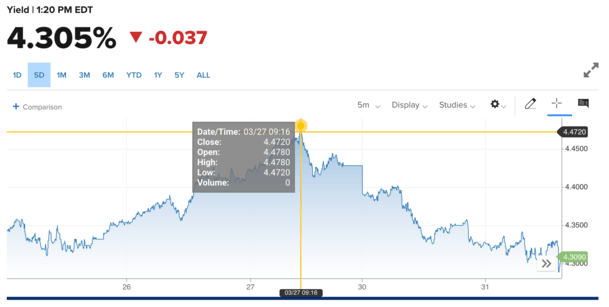
That all spells higher inflation, which led to a big increase in bond yields over the past month.
That rise in the 10-year bond yield corresponded with higher 30-year fixed mortgage rates, with the benchmark rate rising from 3.95% to nearly 4.50%.
Meanwhile, the 30-year fixed climbed from sub-6% levels at the end of February to roughly 6.625%.
Emphasis on rough because the big rate increase happened at the worst possible time of the year, peak spring home buying season.
However, current Fed chair Jerome Powell seemed to shrug off fears of rate hikes due to the Iranian conflict.
While not surprising to me, it might surprise others who feel Powell is the enemy of low mortgage rates.
During the Q&A session, he noted that “We feel like our policy’s in a good place for us to wait and see how that turns out.”
In other words, the sky isn’t necessarily falling, even though oil prices have gone haywire lately and many expect much higher inflation as a result.
This is classic Powell if you’ve been paying attention. He never reacts haphazardly to anything.
He fully understands this is a fluid situation and can change at any given moment. So for the Fed to all of a sudden hike or cut as a result would be out of character.
As such, it’s going to be the status quo, despite what’s happening.
He did add that “We’re getting now an energy shock: no one knows how big it will be. It’s way too early to know.”
And that’s exactly right. We don’t know yet what the impact will be, just as we didn’t know what the impact would be from the tariffs, which also drove mortgage rates higher temporarily.
Perhaps this situation will be short-lived as well, and thus won’t require Fed intervention.
Weak Labor Market Makes Powell’s Job Easier
One thing making the Fed’s job easier (and Powell’s) is the fact that the labor market isn’t too hot right now.
The Fed’s dual mandate is to ensure maximum employment and price stability.
The price stability piece is in question with the recent surge in oil prices, but the employment piece is another story.
There are plenty of signs that labor is struggling, though it’s not yet in full crisis mode.
The latest data delivered today, the Job Openings and Labor Turnover (JOLTS) report, revealed that job openings are down and hiring is the lowest in about six years.
It’s a low-hire, low-fire environment and workers aren’t feeling too confident to leave their existing job and find new work. Nor are employers keen to bring on new talent.
Powell recognizes this, saying “There’s sort of downside risk to the labor market, which suggests keep rates low, but there’s upside risk to inflation, which suggests maybe don’t keep rates low.”
He added that there is “tension between the two objectives,” which explains the do-nothing approach.
Just wait and see what happens and don’t react without fully understanding the entire picture.
And if you look at Fed rate projections, the odds of a rate hike are now basically minuscule again after jumping last week.
Of course, the Fed doesn’t set mortgage rates, but bond traders pay close attention to Fed rate expectations.
Meanwhile, the 10-year bond yield has plummeted nearly 20 basis points (bps) in the past few days, which has led to a mini mortgage rate rally.
And maybe, just maybe, you can thank Jerome Powell for a fair chunk of that.
New tool: Compare offers quickly with my new mortgage rate calculator!
(photo: Federalreserve)

Before creating this site, I worked as an account executive for a wholesale mortgage lender in Los Angeles. My hands-on experience in the early 2000s inspired me to begin writing about mortgages 19 years ago to help prospective (and existing) home buyers better navigate the home loan process. Follow me on X for hot takes.