

The real estate sector started to wake up in February. While the S&P 500 was down 0.9% during the month, the State Street Real Estate Select Sector SPDR ETF (NYSE: XLRE) gained 5.8%.
One stock with a decent yield that performed even better was Chatham Lodging Trust (NYSE: CLDT), which was up 8.4% in February.
The price performance has been impressive, but many investors in real estate investment trusts (REITs) are just as interested in dividends as they are in price appreciation.
Chatham has a respectable 4.8% yield. Can shareholders depend on that dividend in the future?
Chatham Lodging Trust is a hotel REIT. It announced this morning that it is acquiring six new hotel properties, bringing its total portfolio to 42 hotels across 11 brands. Its properties include…
- TownePlace Suites in Austin, Texas
- Courtyard by Marriott in Charleston/Summerville, South Carolina
- Embassy Suites by Hilton in Springfield, Virginia.
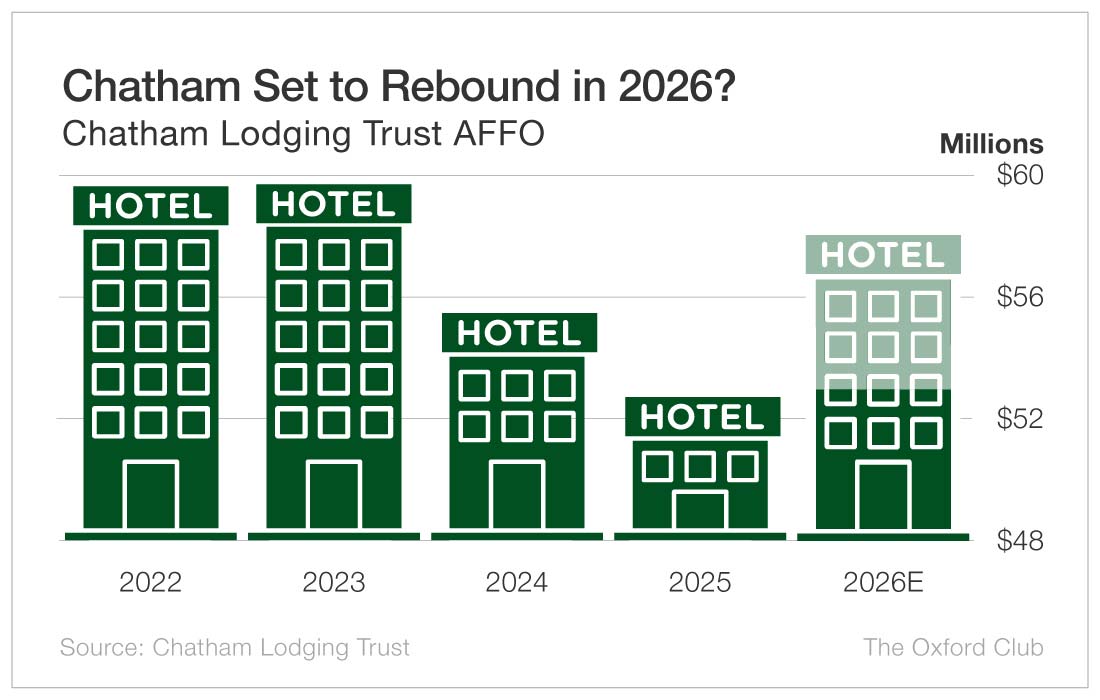
Adjusted funds from operations (AFFO), the measure of cash flow used by Chatham and many other REITs, has fallen in each of the past two years. The $52.7 million total for 2025 was down nearly $3 million from the previous year.
In 2026, management expects AFFO to be in a range of $53 million to $58 million, so they are forecasting growth even at the low end of guidance.
However, the company will still get a penalty on its dividend safety rating for the decline in 2025.
Chatham cut its dividend in early 2020 and did not reinstate it until late 2022. The payout dropped from $0.11 per share monthly to $0.07 per share quarterly. That’s another penalty.
The company paid out $17.6 million in dividends in 2025, which was just 33% of its AFFO. It raised the dividend from $0.09 to $0.10 this morning, but even with the higher payout this year, it likely won’t come close to consuming all of its AFFO.
It looks like the company can afford its dividend this year, but management has shown its willingness to cut the payout. If AFFO continues to slide instead of rising this year as projected, there could be a time when management has to make a tough decision.
Combine that with a recent willingness to cut, and the dividend is not very safe.
Dividend Safety Rating: D

What stock’s dividend safety would you like me to analyze next? Leave the ticker in the comments section.
You can also take a look to see whether we’ve written about your favorite stock recently. Just click on the word “Search” at the top right part of the Wealthy Retirement homepage, type in the company name, and hit “Enter.”
Also, keep in mind that Safety Net can analyze only individual stocks, not exchange-traded funds, mutual funds, or closed-end funds.