
Toru Hanai/Bloomberg
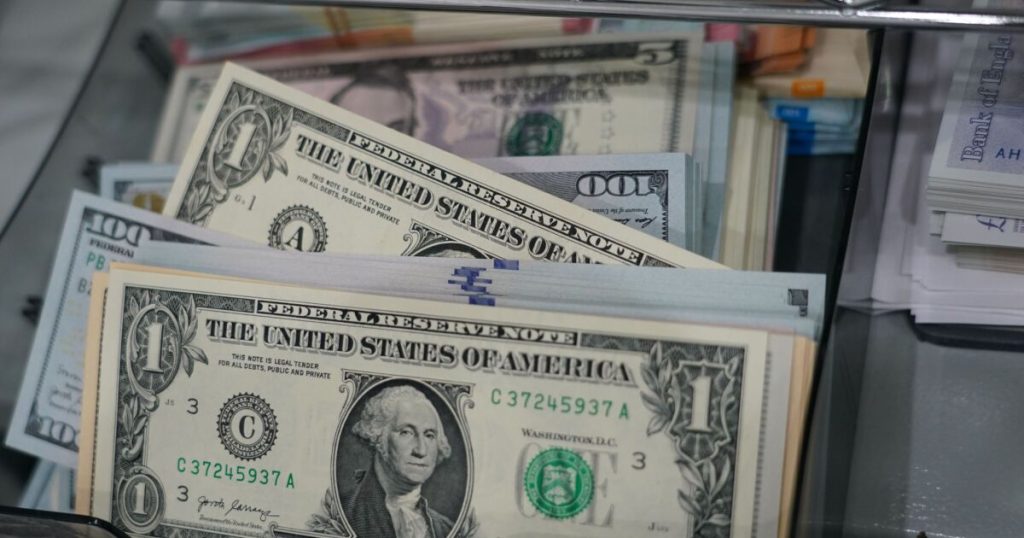
We all assume we know the meaning of the term “dollar.”
But look closely at the easy definitions, and they fall apart. It’s the currency of the United States — but roughly a dozen other countries and territories have adopted the dollar as legal tender, and it is
OK, then, it’s the currency created by the Federal Reserve and authorized American banks — only, European banks also create dollars, a lot of them, as part of the
Comb through established
Former Fed Chair Ben Bernanke, when asked point blank for his definition of a dollar,
It turns out that there is no official definition, something that is becoming increasingly obvious and possibly contentious with the global
The prevailing theory behind the full-throated support from the White House for the development of
However, the theory rests on a bold assumption: that all dollar stablecoin issuers will comply with the U.S. GENIUS Act, or similar legislation in other jurisdictions such as Singapore and Hong Kong that mandate 1:1 backing reserves of short-term U.S. government or central bank liabilities.
Of course, foreign issuers of dollar stablecoins that want to access global pools of liquidity and interact with the networked system will comply.
Those that don’t will end up with niche products and limited use.
But what if that is not a significant barrier for some issuers? What if, for instance, a major state-linked sanctioned Russian bank decided to issue USD stablecoins to more easily settle dollar-based trade invoices from willing partners?
There are obvious obstacles to a Russian entity doing this. One is finding counterparties willing to incur the risk of
Or, what if China were to issue a local USD stablecoin to facilitate regional trade, including with Russia? The Chinese government issues a lot of dollar bonds which could serve as reliable backing reserves; these are now
And sovereign dollar bonds are not the only asset that can act as dollar stablecoin reserves. Kyrgyzstan, for example, recently issued USDKG,
True, the volumes of “unapproved” dollar stablecoins are tiny and unlikely to become significant in the near term. However, given fragmenting trade and building geopolitical tensions, they could. And if they did, it would mean growth in a type of dollar stablecoin that does not boost demand for Treasuries, which could undermine the administration’s stablecoin support.
It would also signal a loss of control over the use of the term “dollar” and its currency code USD.
Presumably, the U.S. authorities will want to stop this from happening. But how?
Also relevant is: Why?
If it’s to stop sanctions-busting, that’s not so easy. Among the Kyrgyzstan entities recently sanctioned were the developers, backers and distributors of
If the motive is to stop the use of the term “dollar,” that’s even more complicated. On what grounds? A currency can’t be trademarked — but an argument could be made for limits on who can use the term given the need to prevent misrepresentation and market confusion. Financial regulation through vocabulary? How would that be enforced?
These stablecoin-related issues bring us back to the initial question: What is a dollar? Technically, we still don’t know.
All this serves as a reminder that, always, new technologies give us cause to rethink well-embedded terms. Arguably, your mobile phone is more a computer than a device on which to receive calls, but the term sticks. Text has become a verb. The envelope icon represents emails that don’t need an envelope.
Crypto continues this tradition. The introduction of bitcoin and its use as a medium of exchange triggered debate around the definition of “money.” And now, stablecoins push us to think about what the term “dollar” means, and who gets to decide.