
Processing Content
- Key insight: The U.S. needs a better-coordinated anti-money-laundering strategy. The Treasury Department’s Financial Crimes Enforcement Network should take the lead in implementing needed reforms.
- What’s at stake: Geopolitical unrest in Venezuela, Iran and Russia has increased the urgency for the United States to improve efforts to identify and intercept illicit finance.
- Export quote: As one AML officer observed a few years ago: It is perfectly possible to run a fully satisfactory and, from the perspective of examiners, even exemplary AML compliance regime without identifying a single serious crime.
More than five years ago, Congress passed a comprehensive
The current administration has
Currently, duplicative examinations are conducted by the federal banking agencies, independent of national law enforcement or national security priorities. Banks spend inordinate resources on outdated tactics and rote searches. As one AML officer observed a few years ago, it is perfectly possible to run a fully satisfactory and, from the perspective of examiners, even exemplary AML compliance regime without identifying a single serious crime. Use off-the-shelf software to generate numerous alerts, investigate each and every alert with equal diligence and write up a report on each with perfect prose — this is the key to success. Meanwhile, geopolitical unrest in Venezuela, Iran and Russia has increased the urgency for the United States to improve efforts to identify and intercept illicit finance.
The key is leadership. The law clearly requires the Treasury Department and its
Fortunately, senior Treasury officials previewed changes in summer 2025 that would examine AML effectiveness based on outcomes rather than technical compliance and would promote the use of innovative technology to combat financial crime. A commitment from Treasury to the Bank Secrecy Act reform agenda would also be a step in the right direction.
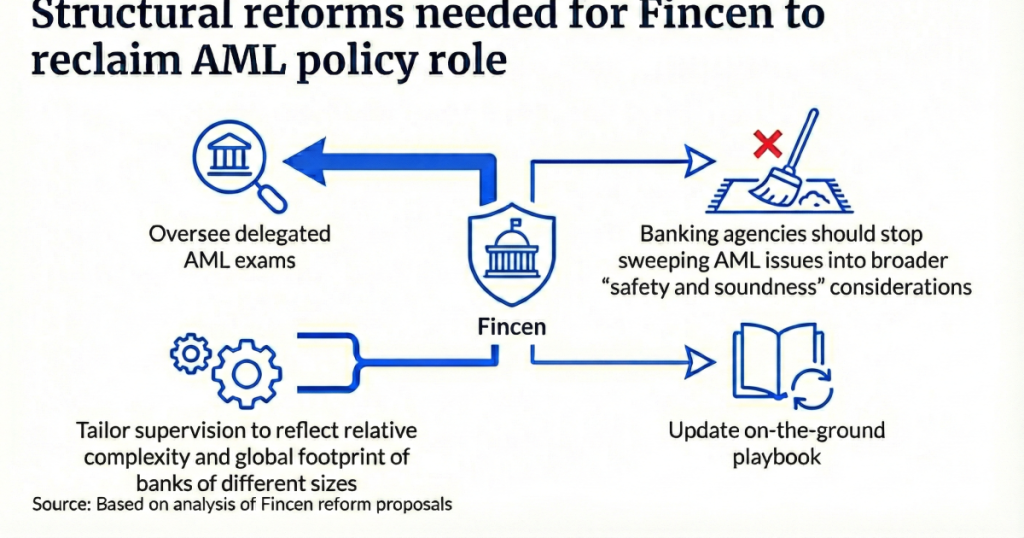
Fincen — and by extension, Treasury — must reclaim its role in dictating AML policy. Doing so requires a concrete set of structural reforms.
First, Fincen should oversee delegated AML examinations, particularly for the largest banks. Fincen should review any supervisory sanction such as a “Matter Requiring Attention” or any alleged violation of law that could lead to an enforcement action. Only Treasury has the knowledge and connective tissue with law enforcement and national security officials to know what is helpful and unhelpful; unlike bank examiners, Treasury officials can also find out whether the reports being filed by a bank are actually effective in practice. Treasury and Fincen should establish the metrics necessary to qualify and quantify what an effective AML program entails. These steps would hold banking agencies accountable in AML examinations, put Fincen appropriately in the driver’s seat and thereby strengthen the U.S. illicit finance regime. And for the very largest, internationally active banks presenting the most complex and important national security issues, Fincen should reclaim all examination authority.
Second, the banking agencies should stop sweeping AML issues into broader “safety and soundness” considerations. This pretext has been used by the prudential agencies to usurp Fincen’s authority as the primary enforcer and overseer of AML programs. To bolster the effectiveness of the U.S. AML regime, this mission creep must be reversed. AML issues should be categorized appropriately as such and deferred to Fincen, rather than falsely labeled as “safety and soundness” issues. A bank that fails to monitor effectively for money laundering should be punished for violating AML laws, not mis-described as being in unsafe financial condition simply for regulatory turf purposes.
Third, AML supervision should be tailored to reflect the relative complexity and global footprint of banks of different sizes. For smaller banks, Fincen should exercise its authority under Section 6307 of the Anti-Money Laundering Act to train and streamline examiners to ensure greater consistency among the agencies.
Fourth, the on-the-ground playbook needs a comprehensive update. The Federal Financial Institutions Examination Council should rescind its AML/CFT Examination Manual, and its replacement should be drafted by Fincen, in consultation with the banking agencies. Any new examination guidance should require examiners to tailor evaluation topics to AML/CFT priorities and information that benefits law enforcement investigations.
The overall AML regime would benefit immensely if banks were permitted to allocate resources to the highest-risk areas and use those resources to target a concise set of national security priorities set by the administration.
With the U.S. facing heightened geopolitical threats and criminals armed with sophisticated evasion techniques, a fortified AML/CFT regime is of paramount importance. The concrete structural reforms outlined above would pave the way for a more focused, streamlined and effective defense against criminal exploitation of the U.S. banking system.