
American Banker’s 2026 Predictions Report
American Banker’s 2026 Predictions report was fielded online during October and November of 2025 among 174 banking professionals who work across a variety of executive roles at banks, credit unions, neobanks and payments companies.
Top findings from the report
Results from the report are highlighted below using interactive charts. Mouse over each section for more detail, click on the chart labels to show or hide sections and use the arrows to cycle between chart views.
This item is part of a series diving into new data from American Banker, so check back for the latest updates.
Processing Content
Part one:
Part four: Coming soon
Part five: Coming soon
Tariff uncertainty will continue in 2026
As the new year kicks off, bankers are most watchful of tariff shakeups and declines in the Federal Reserve’s interest rates.
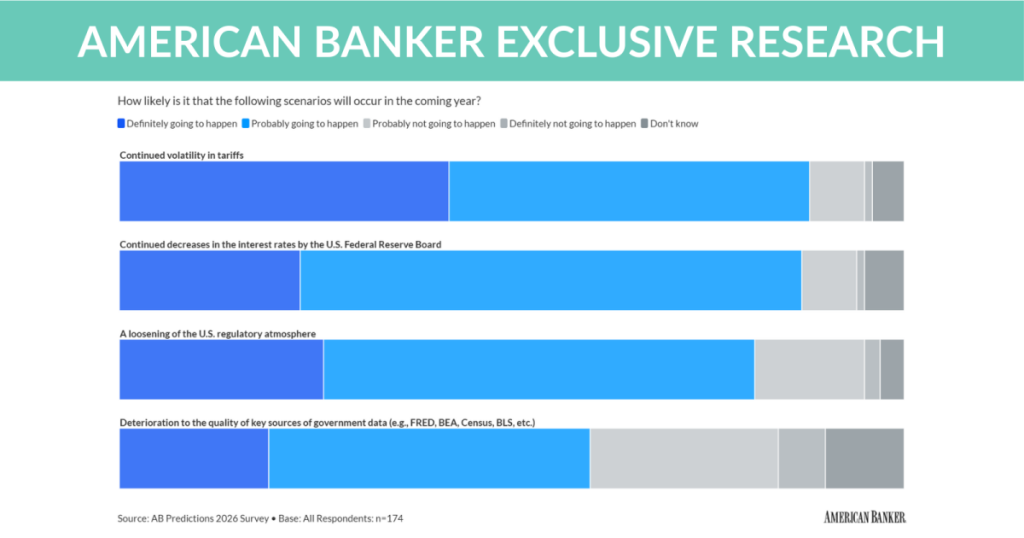
Continued volatility in tariffs was the top trend identified by bankers as most likely to occur in the coming year, with roughly 88% of respondents saying it was either definitely or probably going to happen. Decreases in interest rates by the U.S. Federal Reserve Board was close behind, with 87% responding in kind.
In speaking at American Banker’s Most Powerful Women in Banking conference last October, Meghan Shue, chief investment strategist at Wilmington Trust, said bank M&A activity has been
“We’ve seen an uptick, a pretty decent uptick, in M&A value so far this year,” she said. “Interestingly, M&A volume is still kind of flatlining, which, to me, says you’ve got a few big companies with cash on their balance sheets that are willing to make some big deals, but the small businesses are still handicapped by … the risk and uncertainty around tariffs.”
Loosening of the U.S. regulatory atmosphere was cited by 81% of respondents as a likely occurrence, and deterioration of the quality of key sources of government data (e.g., FRED, BEA, Census, BLS, etc.) was last with 60% of responses.
Tariff volatility stands to pose the most risk to the banking industry as a whole, according to the surveyed bankers. Sixty-eight percent of respondents said this uncertainty could create moderate to high risk for financial institutions.
Deterioration in key governmental data sources ranked higher where risk is concerned, with 61% of bankers saying this trend will pose a moderate to a lot of risk to the industry if it comes to fruition in 2026.
Loosening of the U.S. regulatory environment drew 42% of respondents who said it would create some significant level of risk, followed by 28% who said the same for continued decreases in the interest rates set by the Federal Reserve.
Key takeaway: Tariff volatility is a highly likely threat to the banking industry and will pose significant risk to institutions in 2026.
An economy on the brink
Stagflation and recession will be drags on both the U.S. and global economies, surveyed bankers predict.
“Given these expected price increases, real incomes will fall, and operating costs will rise, which will lead consumers to demand fewer final goods and services and firms to demand fewer inputs. … Ultimately, I see the U.S. as likely to experience lower growth and higher inflation,” Kugler said in remarks delivered at the International Economic Symposium in Dublin last year.
Fifty-six percent of respondents said stagflation within the U.S. is highly likely to happen in 2026, followed by 54% who said the same for a global economic recession and 52% with a U.S. economic recession.
Recession was the main risk prediction among bankers. Thirty percent said a U.S. recession would pose a lot of risk to the banking industry, while a subsequent 47% said a recession would pose a moderate risk. Close behind was a global recession, with 29% saying a lot of risk and 47% saying a moderate risk.
Findings from the
Stagflation in the U.S. economy stands to pose a lot of risk (23%) to a moderate risk (46%) should it come to pass in the near future, according to bankers surveyed by American Banker.
All three trends are forecasted to have notably negative effects on financial institutions, with a U.S. recession in first (80%), followed by a global economic recession (74%) and lastly stagflation in the U.S. (70%).
Key takeaway: More than half of respondents predict that a recession will happen in both the U.S. and global economies.
Volatile regulatory signals worry executives
Volatility is a reoccurring theme for bankers forecasting the state of the industry in 2026.
When surveyed on the current regulatory atmosphere in the U.S., 25% of bankers said regulatory volatility in and of itself was a prime concern.
One of the top regulatory sagas that began in 2025 and has continued to unfold since is the
The whipsawing of the CFPB’s regulatory ire, from targeting “
Other top regulation-related worries include the consequences of deregulation over time (19%), uncertainty surrounding emerging technology and stablecoin (9%) and political tension in the U.S. (7%).
Themes lower down the list include fraud concerns and bad actors (5%), geopolitical concerns (5%), CFPB and consumer protection (3%), the strictness of regulations (3%) and lastly the inability of banks to self-regulate (2%).
Key takeaway: Volatility across the regulatory environment, along with long-term consequences of deregulation and emerging technology woes, have bankers worried about industry governance for the months ahead.
Which bankers are most and least prepared?
The banking regulatory environment might be unpredictable for the time being, but banks and credit unions are working proactively to shore up any possible risks created in this environment.
Seventy-three percent of respondents from banks with more than $100 billion of assets are confident that their institutions are doing enough to address the potential risks posed by loosening regulations, followed by 69% of midsized/regional banks and 67% of community banks who said the same.
Credit unions were more pessimistic. This group had the lowest percentage (57%) to say they were adequately addressing risks, and also had the largest share (24%) reporting that their institutions weren’t doing enough.
In a
“Savvy leaders have always known that no two financial institutions are exactly alike and that there’s no single best way of supervising them and no best way for them to operate,” Rushton said. “Likewise, savvy examiners have always been able to look through the form to the substance of banking risk, and this streamlining should help them do that.”
Key takeaway: Most banks and credit unions are confident that their organizations are doing enough to protect against risks from regulatory loosening.
The Federal Reserve’s trust problem
Bankers’ levels of trust in the Federal Reserve have changed over the previous 12 months, with more than one-third of respondents losing confidence.
Thirty-eight percent of bankers surveyed said they trust the decisions of the Federal Reserve Board less or a lot less than they did before. A separate 46% said they have less or a lot less trust in the board’s ability to act independently (without partisanship) and another 38% lost faith in the credibility of the board.
Smaller shares of respondents said their opinions trended upward in 2025. Seventeen percent had more trust in the board’s decisions; 16% in the board’s independence; and 20% in the board’s credibility.
This year, the Fed faces
Key takeaway: Roughly one-third of bankers lost faith in the Federal Reserve Board to some degree in 2025, while two-thirds’ trust stayed the same or grew.
Is open banking another risk?
Open banking became a popular topic among bankers in 2025, and is continuing its rise in popularity into 2026. But executives are wary of both the upsides and the downsides of the regulatory changes in this area, specifically the CFPB’s creation and subsequent abandonment of its Dodd-Frank Act 1033 data-share rule, which the agency is in the process of rewriting..
Open banking, the framework for allowing consumers to share their financial data such as transaction history and account balances between financial institutions, has been a concept for more than 20 years but formally debuted following the signing of the
Just 6% of respondents said open banking is a key offensive tool to help attract deposits and new customers. By contrast, 22% of bankers are on the defensive, focusing on protecting sensitive customer data. The largest share of respondents, 68%, recognized that the technology has both opportunities and risks.
The CFPB announced its plans in December to issue an “interim” final rule on open banking that could
Key takeaway: The majority of bankers are in the camp that open banking rules will bring positives and negatives to those who use the technology.