
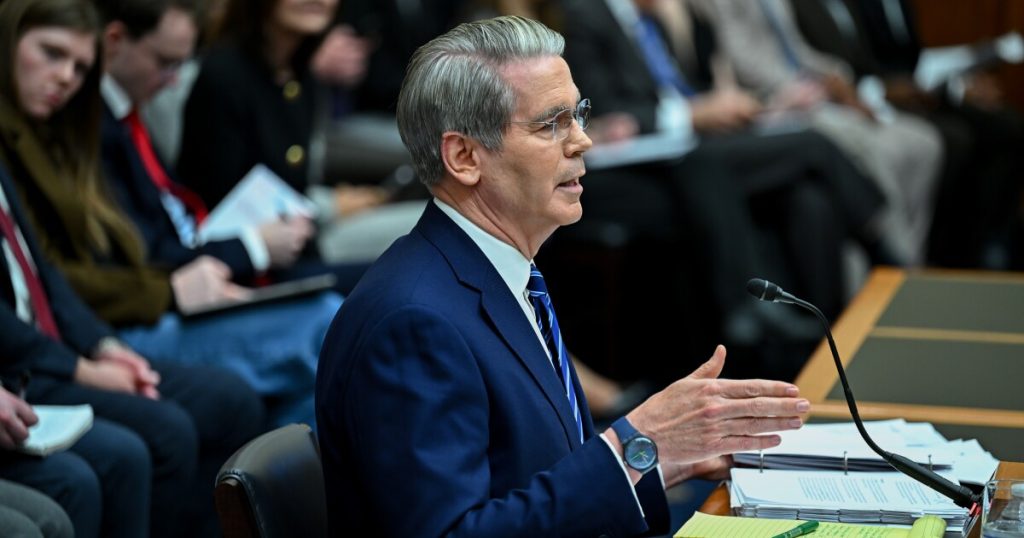
- Key insight: Treasury Secretary Scott Bessent said that the smallest banks should be deregulated, but didn’t endorse any specific policies to do so.
- Forward look: Chairman French Hill’s, R-Ark., community bank policy package has been overtaken by crypto bills and other priorities on the House floor and the Senate.
- Expert quote: “Stop being his flunky.” — Rep. Gregory Meeks, D-N.Y., to Bessent, referring to President Donald Trump.
WASHINGTON — In a hearing that was high on drama and low on policy substance, Treasury Secretary Scott Bessent said that the Treasury Department would embark on a
Processing Content
At several points, Bessent and Democratic lawmakers — chiefly House Financial Services Committee ranking member Maxine Waters, D-Calif., and Rep. Gregory Meeks, D-N.Y. — spoke over each other at length. Bessent even earned a rare warning from the panel’s chairman, Rep. French Hill, R-Ark., to honor procedural rules that allow lawmakers to direct questions and control their allotted time.
At one point, Meeks asked whether Treasury would investigate World Liberty Financial, the Trump-connected crypto firm that
“I’m not going to ask much of you, Mr. Secretary. I just want to know whether you will commit today to pause and heighten the scrutiny of any bank charter or licensing application at the OCC connected to World Liberty Financial,” Meeks said.
The incident set off an extended period of raised voices between the two men.
“Stop being his flunky,” Meeks shouted at one point, referring to Bessent and Trump.
Bessent consistently talked about the importance of small banks, but offered little in the way of specifics about what that looks like from his perch as Treasury and as head of the Financial Stability Oversight Council.
“Regulation by reflex has led to a regulatory myopia that has undermined safety and soundness,” Bessent said in his prepared remarks.
Bessent blamed Biden-era bank regulation and a focus on “reputation risk” and climate-related financial risk for the Silicon Valley Bank crisis, repeating a narrative espoused by many Republicans in Congress at the time.
“Besides undermining safety and soundness, regulation by reflex has driven excessive regulation,” Bessent said. “That can lead to economic stagnation. And economic stagnation is, itself, a threat to financial stability.”
Bessent said that federal agencies “must avoid the temptation to create a zero-risk financial system, which would result in what others have called, ‘the stability of the graveyard.'”
“FSOC should aim to identify vulnerabilities that could lead to systemic crises and encourage the private sector to mitigate those risks before recommending additional regulation. FSOC should also work with its members to support efforts to avoid or pare back existing regulation that stifles pro-growth lending, capital formation, and innovation,” he said. “And the best way to achieve these goals is by centering economic growth and economic security at the heart of FSOC’s agenda.”
As head of FSOC, Bessent has the power to convene financial regulators in the forum.
“We have tried to get them aligned on what they’re doing,” he said of community bank regulation.
Hill secured Bessent’s support for some of his legislation tailoring capital requirements and risk oversight for community banks, which Hill has tried to make a hallmark of his chairmanship.
His efforts have hit some roadblocks though, as
The support of the administration could be key to getting a community bank package through the committee and to the Senate floor for a vote. Bessent said that community banks should have tailored capital and risk standards.
“It’s Main Street’s turn, and essential to Main Street having its turn are small community banks,” Bessent said. “Thanks to onerous regulation … community and small banks became too small to succeed.”
Rep. Emmanuel Cleaver, D-Mo., asked Bessent about the Fed’s independence in the face of unprecedented incursions by the White House into the central bank’s longstanding independence from politics. Bessent said he supports the Fed’s independence, but added that there must also be “accountability.”
“We’ve seen these cost overruns. The … independence of the Fed is based on its trust with the American people, and the Federal Reserve lost the trust of the American people when it … allowed the greatest inflation of 49 years to ravage, ravage working people in this country,” Bessent said.
Later in the hearing, when asked whether the Fed was executive or legislative in nature, Bessent said he viewed the central bank as “independent.” When pressed about whether that meant it was neither executive nor legislative, Bessent replied, “We’ll see.”
Bessent added that the Fed’s non-monetary policy duties and activities don’t comport with its presumed independence from politics.
“The Federal Reserve should be independent for monetary policy, and every other program it undertakes impinges on the monetary policy independence — whether it is cost overruns on a building, whether it is including the climate, whether it is offering political opinion,” Bessent said.
When asked for his views on President Trump’s proposed
“The President is interested in affordability for the American people, and I think his view is that banks have done very well, and that by capping the rate for one year, it would give the American people the chance to recover,” he said.
He seemed to refute banking industry arguments on how an interest rate cap would affect subprime borrowers, saying that banks could figure something out with credit card reward programs instead.
“Subprime borrowers are paying higher [Annual Percentage Rate], and the upper-end borrowers are getting more rewards,” Bessent said. “So maybe there’s a calculus here on how to diminish the rewards, and cut the APR.”
Ebrima Santos Sanneh and John Heltman contributed to this report.