
- Key insights: Visa has added new technology to make it easier for issuers to access subscription management.
- What’s at stake: Consumers underestimate how much they are paying for streaming content and other subscription services, creating demand for better visibility into expenses and the ability to easily cancel services.
- Forward look: Visa will gradually roll out the new technology globally in the coming months.
As television has morphed from cable to streaming services and consumers turn to subscriptions for a variety of services, the pile of monthly bills has become a mess – or at least that’s how Visa and Mastercard see it.
“We’re signing up for these subscriptions more than ever,” Kathleen Pierce-Gilmore, global head of issuing solutions at Visa, told American Banker. “I signed up for a frozen treat subscription at one point.”Visa just updated its existing subscription management service in an attempt to make it easier for card issuers to sell management tools to consumers, who can view their subscriptions, find out how much they are paying and make changes through a single portal.
Processing Content
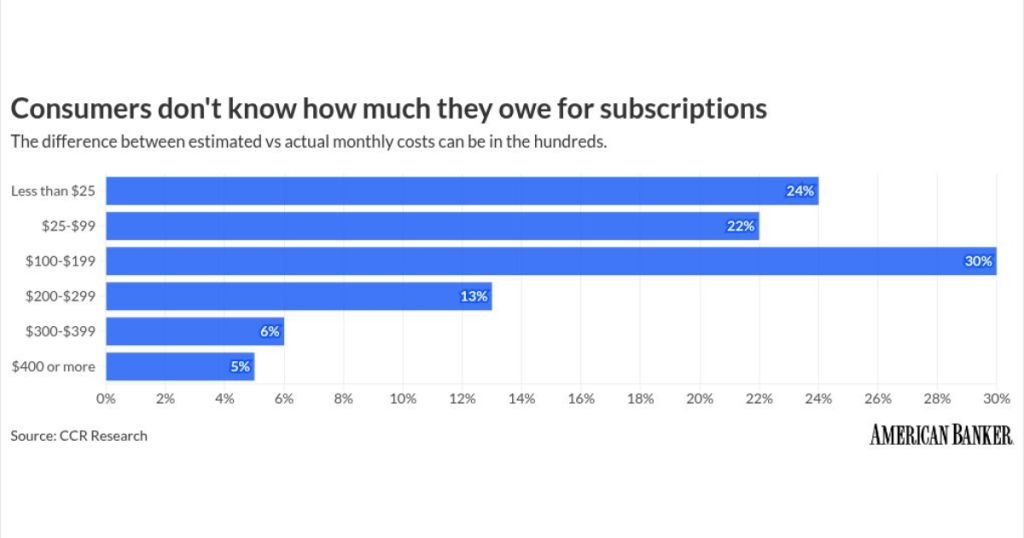
There is potential demand for better visibility for subscription payments. Consumers spend an average of $219 each month for subscriptions, while estimating they are paying $86, according to
“Card networks sit at the center of transactions and merchants’ branded card programs. This visibility enables them to identify recurring transactions, look for repeated transactions, and standardize merchant names, which helps in retention and dispute reduction,” Brian Riley, co-head of payments and director of the credit and risk advisory service at Javelin Strategy & Research, told American Banker.
Visa’s subscriber hub
Offering a digital concierge for consumers to change and cancel online subscriptions is not a new idea –
Visa is adding access to a developer toolkit to simplify the actual concierge function, which Pierce-Gilmore contends has itself become unwieldy as the subscription market proliferates.
“People will be able to see all of these subscriptions and make any changes,” Pierce-Gilmore said. “It’s hard for them to do that now.”
Visa is collaborating with Pinwheel, a technology firm that sells in-app bill management software. The card network and Pinwheel will offer a digital view of a user’s subscriptions and will enable changes in payment methods, upgrades and cancellations. The subscription manager is part of Visa’s Digital Issuers Solutions unit, one of the non-payment services that Visa has added over the years to
These value added services also include Visa’s software development kit, which will embed in Visa’s updated subscription service, enabling issuers to combine different subscription-related functions.
The update is predicated on the idea that consumers have added subscriptions at a rate that makes them hard to track and contributes to over payment. To market the subscription service, Visa released a survey from Pinwheel that reports 75% of consumers want in-app bill management and more than 50% of Millennials and Gen Z consumers would switch banks based on availability.
Visa argues its centralized SDK simplifies the work of managing subscriptions on behalf of card issuers – and its scale provides a reach that digital-payment companies do not necessarily have. And while large banks such as
“An issuer could build this type of experience internally, but they would have to hook into a number of [application programming interfaces], not just for Visa but many other players as well,” Pierce-Gilmore said. “We have built the user interface and have pieced these APIs together to make it easier and more visual for the issuers.”
Visa’s new subscription manager will be available for North American issuers this summer, followed by expansion to Latin America and the Caribbean.
Other options
In addition to banks and fintechs, rival Mastercard also offers subscription management. Mastercard’s services include an
The number of banks and credit unions to offer subscription management will grow steadily through the next year because it offers many benefits for the card issuer and the customer, according to David Shipper, an advisor at Datos Insights.
“The card networks may have some advantages since card networks are involved in the entire transaction, which could make for an easier implementation for the card issuer,” Shipper said. “There are also benefits from a vendor-management perspective since the network is already a partner. Outside of that, I am not certain that the product is functionally better than other solutions in the market.”