
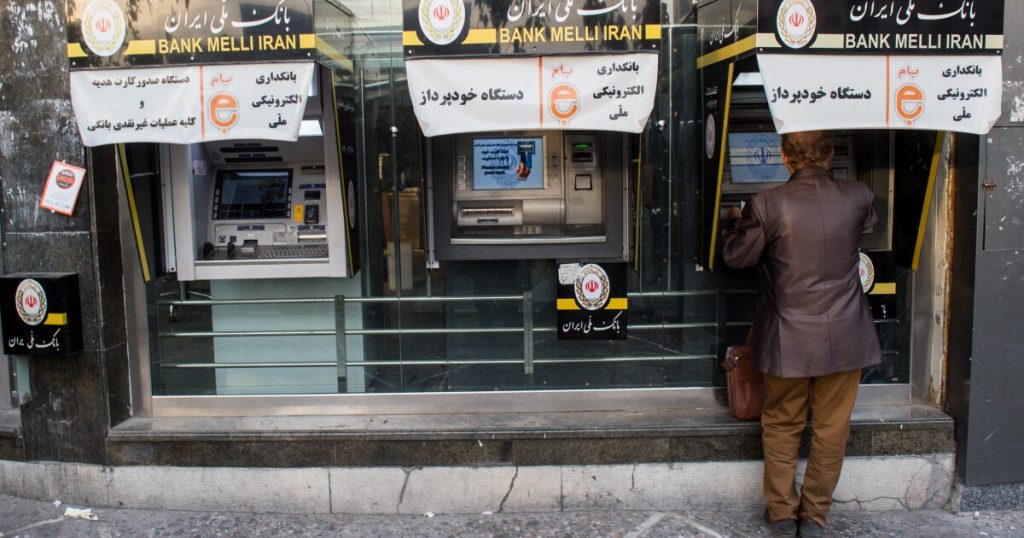
- Key insights: Fifty years of sanctions has forced Iran to develop its own isolated financial system. But money has still found a way to move in and out of the country.
- What’s at stake: The most recent war in Iran reflects ongoing disarmament efforts by the U.S.
- Forward look: President Donald Trump has said he expects the military operation to last four to five weeks.
Iran’s payments and banking system looks a lot different than other financial systems across the world.
Processing Content
That’s largely due to sanctions levied by the U.S., U.N. and E.U. These sanctions began in 1979 in response to the Iranian Hostage Crisis, and have since come in response to multiple nuclear proliferation concerns and human rights violations. The sanctions have limited American companies’ — including Visa, Mastercard and American Express — ability to do business in the country. Iran’s access to global financial systems has also been limited.
“Iran is one of the more heavily sanctioned countries in the world,” Philip Nichols, a professor at the University of Pennsylvania’s Wharton School whose research focuses on corruption, emerging economies, international trade and investment, told American Banker. “There’s some really interesting things that have happened in Iran because of the sanctions.”
Those sanctions have had lasting, albeit changing, effects on the country’s payment system over the years, both in the way money moves in and out of the country and the way Iranians interact with the wider global economy.
The current sanctions have been in place for 15 years, after President Barack Obama sanctioned Iran’s central bank and Swift kicked Iran out of the world payment system, Djavad Salehi‐Isfahani, a professor of Economics at Virginia Tech, told American Banker. Salehi-Isfahani’s research focuses on economic sanctions, inequality and the economics of family in the Middle East.
Banks in Russia have also been
“That’s when Iran’s banking system was dealt a big shock,” Salehi‐Isfahani. “But before that, it was okay. There were always big public banks and private banks, and they worked like in most developing countries.”
Impact of sanctions inside Iran
Today, Iranians cannot make payments on the international system and cannot open accounts in foreign banks. Similarly, foreigners cannot make payments in Iran using traditional card rails such as Visa, Mastercard or American Express.
That isolation from Swift and other banking systems has given birth to an internal financial system, including its own payment system called Shaparak that supports debit and credit cards, and an interbank network called Shetab.
“Iranians use these ATM cards for everything, [including] money transfers,” Salehi‐Isfahani said. “They don’t need something like Venmo, for example, you just ask the other person’s card number, ITN number, and you make a transaction on your computer or at an ATM.”
Iran also has a large ATM network. In 2018, ATMs per 1000 square kilometers amounted to 33.8, according to the most recent data from the International Monetary Fund, and there were 88.7 ATMs per 100,000 adults. Iran stopped providing economic data to the IMF when the Trump administration withdrew from an Obama-era international nuclear agreement with Iran, called the Joint Comprehensive Plan of Action.
“The ATMs across Iran that came about when they raised energy prices in 2010 just before the sanctions, and gave everybody an ATM card so the government could compensate them for the higher energy prices,” Salehi‐Isfahani said. “The IMF admired it, and as a result of that, every village had an ATM. And that level of technological sophistication came in because the government was not a government of no laws, not completely focused on world terror. They really wanted to help the poor survive the higher energy prices.”
Iran’s payment system may not be connected to the rest of the world, but it does work well inside Iran for transactions, he said. “In fact, it works so well that I think the velocity of money the economists pay attention to has increased, which is a way of saying there is more money around than there used to be, even without more printing of money.”
Shaparak processes more than 50 million transactions annually, according to the Financial Tribune, a privately-owned English-language newspaper in Iran.
While traditional cards won’t work on the Shaparak network, tourists are issued a card on arrival that they can use on Iranian apps, Nichols said.
“It’s not like Cuba, where they haven’t been able to develop a homegrown [financial system],” Nichols said. “Iran has its own digital financial system, its own online financial infrastructure.” That includes similar services like Uber and Doordash.
“I doubt that Iran would have developed its own financial clearing houses and its own system in the absence of the sanctions,” Nichols said. “But we can’t know that for certain.”
Money finds a way to move
Despite sanctions that have limited Iranians’ ability to participate in the global payments system and export goods and services, money has still found a way to move in and out of the country for its biggest export: oil.
“Oil is mostly handled by the government and so they can manage to get around these financial sanctions, mostly by sending ships to China full of oil or petrochemicals and getting paid for it in kind, or in Chinese currency,” Salehi‐Isfahani said. “The difference between being in the world financial system and being outside of it is that you are limited to barter systems.”
But Iran in the past has found other ways to circumvent sanctions, especially when the U.S. and the European Union were not aligned, Nichols said.
“That’s actually important for how we think about Iran’s payment mechanisms, because Europe remained open, but the United States was sanctioning, and that affected particularly how countries like India paid for oil from Iran,” he said.
A substantial amount of India’s oil comes from Iran, Nichols said. “Once the U.S. barred Iran from its payment system, India began changing its dollar payments to rupee payments, and began funneling those payments through German banks that had relationships with Iranian banks. But once the European Union levied sanctions on Iran and removed it from Swift, those payments flowed through Turkish banks. And when Turkey was inclined to join Western countries with respect to Iran, money would flow from Indian banks to banks in the United Arab Emirates before arriving in Iran.
“It’s more expensive to do it this way. It takes more time because the U.S.-dominated system’s scale is huge,” Nichols said.