
- Key insights: Revolut, Tether and Circle made announcements this week designed to boost their stablecoin profiles.
- What’s at stake: Stablecoins are growing quickly and are attracting investment, creating an arms race among banks and fintechs.
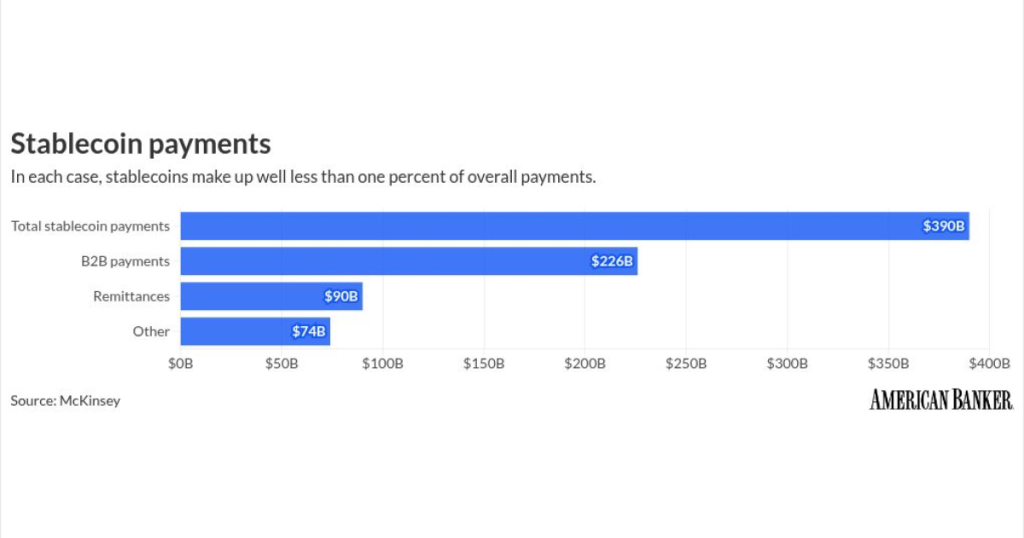
- Forward look: Despite the growth in stablecoins, McKinsey says stablecoin payments are still a small part of the overall payments market.
One of the big stories in the payments industry over the past year has been stablecoins, which have gotten a
Processing Content
But the story appears to be outracing the reality. Even with fast growth the market is very small, according to
There are about $300 billion in stablecoins circulating, according to McKinsey, adding that’s up from less than $30 billion in 2020. McKinsey also noted projections from U.S. Treasury Secretary Scott Bessent that the stablecoin supply could reach $3 trillion by 2030. And financial institutions peg the supply could reach as high as $4 trillion in the same time frame.
But that’s not the payments market. McKinsey partnered with blockchain analytics firm Artemis Analytics to separate trading, internal fund movements and automated activity from payments. After running those numbers through the strainer, McKinsey found that actual stablecoin payments totaled closer to $390 billion in 2025 — or about 0.02% of global payments volume. And even for use cases such as B2B payments and remittances, stablecoins are gains of sand on the beach.
For B2B payments, stablecoins totaled about $226 billion in 2026, or about 0.01% of the global B2B payment volume of about $1.6 quadrillion, McKinsey said. And for remittances, there were $90 billion in stablecoin payments volumes, which is less than 1% of the more than $100 trillion in total volumes from this segment, McKinsey said.
There are benefits to stablecoins, McKinsey said, such as addressing inefficiencies in cross-border payments. They just aren’t being used for that yet.
And banks are interested. Forty-seven percent of banks say their institution’s clients were asking for general information about cryptocurrency, followed by 35% who said clients were asking for the ability to make payments using cryptocurrencies, according to
Given the growth and anticipated demand, there’s plenty of investment in stablecoins, with several announcements in just the past few days.
Tiffany Hagler-Geard/Bloomberg
Tether invests in web market Whop
In an effort to extend stablecoins deeper into what it calls “real economic activity,” stablecoin issuer Tether has made an investment in Whop, an internet marketplace.
The size of the investment was not disclosed. Tether hopes the resulting partnership will enable easier processing for customers who use USDT and USAT for international payments, avoiding what Tether says is a complicated exchange process. Whop’s platform supports more than 18.4 million users, with participants earning approximately $3 billion annually.
Tether’s funding round will support expansion in Latin America, Europe and Asia-Pacific. “Stablecoins and wallets become most powerful when they are embedded directly into people’s lives, supporting their businesses, activities, families and individual stories,” Paolo Ardoino, CEO of Tether, said in a release.
In an earlier

Stefani Reynolds/Bloomberg
Circle touts stablecoin growth
The boost in attention that
“The fourth quarter marked another step forward in Circle’s mission to build the infrastructure for an open, programmable internet financial system,” said Jeremy Allaire, co-founder and CEO of Circle, in a release. Circle has gotten a boost from initiatives such as the
Circle in the past year has also added scale through

ADRIAN DENNIS/Photographer: Adrian Dennis/AFP/
Revolut joins a UK stablecoin sandbox
The Financial Conduct Authority has chosen London fintech Revolut to test stablecoin technology in a “sandbox,” which refers to a lab setting with less regulatory pressure than a real-world environment.
The FCA, which said it got 20 applications, also chose fintechs Monee Financial Technologies, ReStabilise and VVTX. These firms will study how stablecoins would perform given pending regulations and economic risk. The first use cases will be payments, wholesale settlement and crypto trading ahead of regulations that go into effect in September.
The U.K. has come under fire for its relatively slow pace in
“We are supporting U.K. stablecoin issuers to ensure they can be trusted for payments, settlement and trading. It will benefit consumers and financial transactions and help to deliver the FCA’s strategy and the Government’s National Payments Vision,” Matthew Long, director of payments and digital assets at the FCA, said in a release.

Visa boosts its profile in Argentina
In global payments news this week outside of stablecoins, Visa has agreed to acquire Prisma and Newpay from private equity firm Advent International. Both firms sell primarily to clients in Argentina. Prisma offers credit, debit and prepaid cards.
Newpay offers real-time payments, and manages the local Benelco ATM network and bill payment platform PagoMisCuentas. Visa plans to pair the two firms to accelerate deployment of tokenization, biometric authentication, advance risk management and agentic commerce. Terms were not disclosed, and Visa said the deal is expected to close in the second quarter.
“This acquisition is an important step for Visa in Argentina, strengthening our client partnerships and advancing innovation across the payments ecosystem,” said Ryan McInerney, CEO of Visa, in a
Both

Worldline updates payments tech to fuel turnaround
French payments processor Wordline has integrated several merchant products to support shopping and payment experiences that cross channels such as mobile, online and in-store.
Called One Commerce, the firm is attempting to address “
Worldline will also introduce an “à-la-carte” acquiring model, which enables merchants to choose their preferred acquires, with Worldline’s merchant acquiring service being among the options.
“Worldline One Commerce is a strategic shift for retailers. It transforms payments from a transactional necessity into a powerful enabler of growth, efficiency and customer engagement. Our ambition is clear: to help merchants scale faster, innovate with confidence and deliver truly seamless omnichannel experiences,” David Valero Compte, global head of retail at Worldline Enterprise, said in a release.
Worldline, which is restructuring amid

Melinda Huspen/American Banker
Fiserv picks up distribution in Canada
Like Worldline, Fiserv is also battling an earnings slump. Fiserv has partnered with Canadian technology company Peoples Group to sell a suite of payments technology covering real-time processing, e-commerce and other tools.
Fiserv has entered into a series of partnerships in recent months as it looks to recover from an
Fiserv is also working with Google, Mastercard and Visa to expand agentic commerce, which refers to a form of AI that enables shopping and payments with little or no human supervision. “Peoples Group is at the leading edge of innovation in Canada’s financial ecosystem, and we’re proud to support their next-generation payments strategy,” said Sayantan Chakraborty, head of digital Payments at Fiserv, in a release. “With the Fiserv Enterprise Payments Platform, we’re delivering the scale, security and connectivity financial institutions and fintechs need to grow and compete across Canada.”

Chris Ratcliffe/Bloomberg
MoneyGram lends its scale to UK blockchain project
Transfer giant MoneyGram has joined Vodafone and eToro in running three of the ten nodes for a new blockchain from the Midnight Foundation, a decentralized commerce organization. The three companies will each run a “node,” which means they are one of the users and operators of a shared network.
MoneyGram will also work with the Midnight Foundation to find ways for traditional payment networks to adopt blockchains while managing inhibiting factors such as privacy, compliance and security. Like rival Western Union, MoneyGram has
“MoneyGram has been delivering real-world crypto solutions for years, focusing on making the benefits of digital finance accessible to the people who actually need them,” said Luke Tuttle, MoneyGram chief product and technology officer, in a release. “Working with Midnight and running blockchain nodes fits naturally into this strategy, allowing us to help ensure that privacy, compliance and reliability are built in from day one.”