
- Key insight: Main Street Loan Program borrowers say an uncompromising approach to troubled loans threatens to push viable companies into bankruptcy.
- Why it matters: A program that was intended to offer businesses a lifeline during the COVID-19 pandemic has led to the demise of some of the companies it was meant to save.
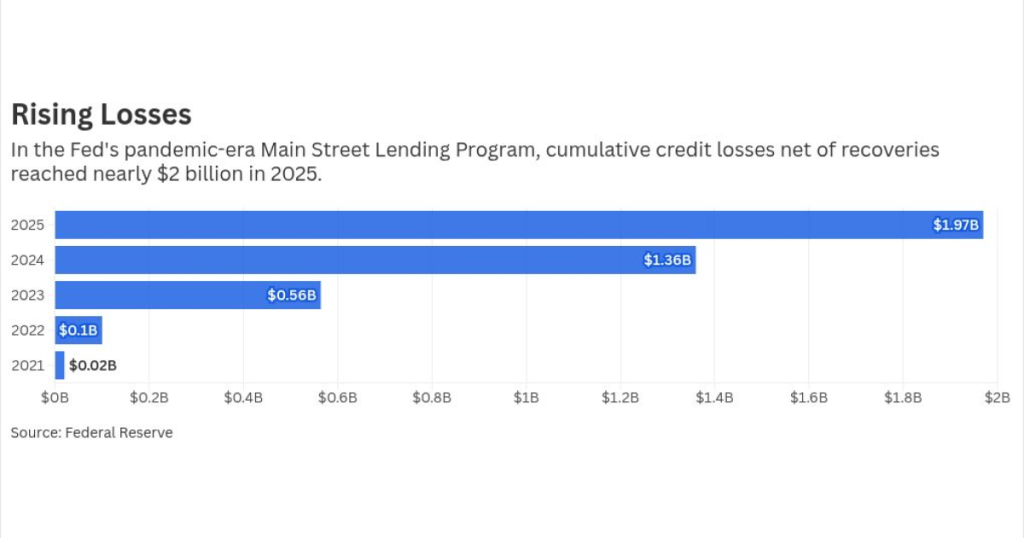
- Supporting data: The program’s net loan losses have spiked since 2022, reaching $1.97 billion at the end of last year.
The Federal Reserve’s Main Street Loan Program, a COVID-era relief effort that made loans to medium-sized businesses, will soon be history.
Processing Content
Just $43.9 million of the $17.5 billion loaned under the program remains outstanding, with all individual credits coming due this year, according to the Fed’s most recent update,
But for scores of borrowers, including the handful with loans still outstanding, the outcome has been much less positive. Indeed, some borrowers say the program’s structure, along with the government’s reluctance to negotiate, has made modifying troubled deals difficult, if not impossible, and they’ve been forced to sell their companies, liquidate assets or file for bankruptcy.
In other words, an initiative that was intended to offer businesses a lifeline during the COVID-19 pandemic led to the demise of some of the companies it was intended to save.
One such firm,
“We’ve been asking for this for probably eight to nine months,” CEO Michele Van Tilborg told American Banker in an interview. “We didn’t just wake up and go, `Oh my gosh, let’s get a refi.’ We’ve been working on this for a long time.”
“There’s been no communication,” added Colin Campbell, a noted entrepreneur and author who is one of Paw.com’s investors.
Another Main Street borrower, who asked not to be named because he fears antagonizing people he hopes to negotiate with, told American Banker that his modification requests have gone unanswered, despite his assertion that the restructuring he is proposing would result in a significantly larger payout than a looming bankruptcy filing. Though this borrower continues to seek a loan modification, he is also hopeful that the Fed will opt to sell the Main Street portfolio.
“Let the private market correct the situation and not some Fed guideline that’s deaf and dumb to the realities behind it,” the borrower said.
The Main Street Lending Program, which was designed for businesses too large to qualify for the Paycheck Protection Program, failed to catch on in a major way — despite $600 billion of lending capacity and a
After the program’s launch in April 2020, it made only 1,830 loans. Originations ceased nine months later, in January 2021. Banks originated the loans, but the Fed purchased 95% stakes in them.
While most Main Street borrowers managed to navigate the program successfully and repaid their obligations, many struggled. Indeed, since 2022, net loan losses have surged, reaching a cumulative total of $1.97 billion at the end of last year.
A number of borrowers, including transport company Coach USA and fast-food franchisee Starboard Group, have cited Main Street loans as contributing factors when they’ve filed for bankruptcy.
Borrowers have cited Main Street’s payment schedule, which requires a 70% balloon payment at the end of the loans’ five-year terms, as a major hurdle. Those struggling to make their payments have also criticized what they’ve described as the Fed’s unwillingness to negotiate.
According to Ben Gonzalez, a managing partner at investment banking firm Harney Partners in Austin, Texas, distressed Main Street borrowers are largely frozen in place since most can’t obtain enough private-sector financing to pay their debt in full.
Some borrowers “just couldn’t realistically” find an alternative lender, Gonzalez told American Banker in an interview. “The clients weren’t proactive enough, or they didn’t have any options.”
The Federal Reserve Bank of Boston, which administers Main Street, has agreed to relatively few extensions or payment deferrals, according to
“There are no release valves, from what we have learned,” Van Tilborg said.
The situation is pushing viable businesses to the brink of closure, according to both
“Paw.com is a great company with great products, but it was just too hard to make that balloon payment under these terms,” Campbell said in a press release the company distributed on Jan. 8. “It’s a shame that a program designed to help small businesses survive the COVID pandemic has ended by forcing small businesses to pay up or go under.”
“Unfortunately, that has its ramifications,” Campbell told American Banker. “We’re shutting down warehouses and laying off employees. It will be a smaller company once we get through this.”
A Federal Reserve Bank of Boston spokesperson said in a statement that the Fed “cannot modify terms of Main Street loans broadly,” but that it does consider potential loan modifications on a case-by-case basis in consultation with the bank lender.
“We remain focused on the path forward and will continue to partner with lenders and key stakeholders on navigating through the remaining challenges with the borrower and taxpayers in mind,” the Boston Fed spokesperson said.
But Gonzalez, who has written about Main Street, said its structure and regulations limit the Fed’s flexibility. Gonzalez and other observers said nothing is likely to change without action by Congress or the executive branch.
“They can’t make a rational decision,” Gonzalez said. “They’re just stuck with it. … They are structurally barred from accepting any offers in compromise.”