
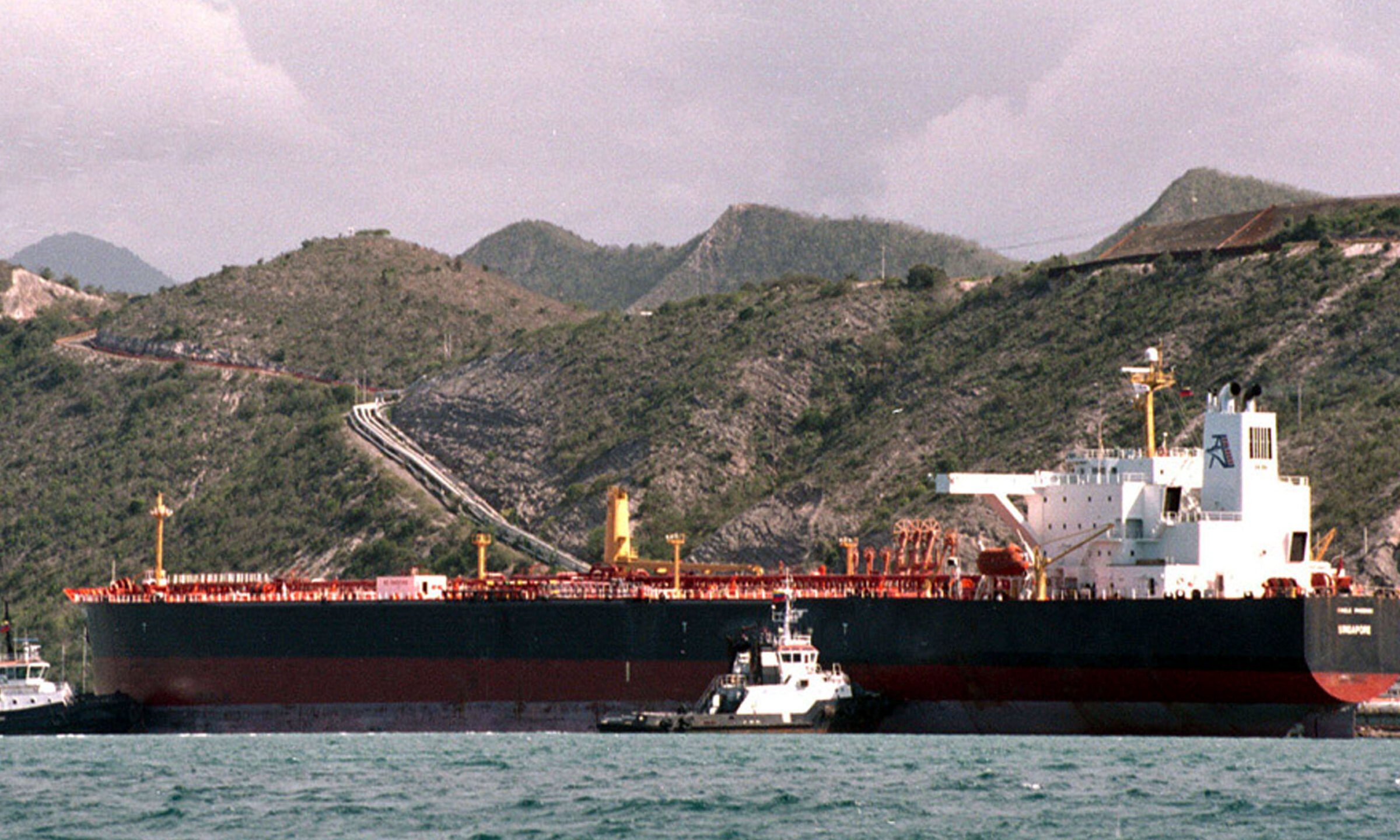
U.S. drivers may be wondering whether President Donald Trump’s push to tap Venezuela’s massive oil reserves will translate into lower gas prices.
On Jan. 3, following the ouster of Venezuelan President Nicolás Maduro, Trump said at a press conference, “We are going to have our very large U.S. oil companies go in, spend billions of dollars, fix the broken oil infrastructure and start making money.”
Trump lays out U.S. takeover of Venezuelan oil
On Jan. 3, the U.S. military struck Venezuela, capturing Maduro and his wife and extraditing them to New York on drug-trafficking charges. Hours later, Trump said the U.S. would “run” Venezuela, opening its vast oil reserves and critical minerals to American firms.
In the days that followed, Trump detailed what controlling Venezuela’s oil would look like.
In a Jan. 5 post on Truth Social, he said the U.S. would receive between 30 million and 50 million barrels of sanctioned Venezuelan oil, with proceeds controlled by the U.S. government. He said, “This Oil will be sold at its Market Price, and that money will be controlled by me, as President of the United States of America, to ensure it is used to benefit the people of Venezuela and the United States!”
Two days later, Trump said Venezuela would be allowed to buy “ONLY” American-made products with revenue from the 30 million to 50 million barrels of oil. That same day, White House officials confirmed plans to assume control of Venezuela’s oil sector for an indefinite period.
Trump reinforced that message in a Jan. 8 interview with The New York Times, saying the U.S. would maintain a long-term presence in Venezuela to extract oil from its reserves. “We’re going to be using oil, and we’re going to be taking oil,” Trump said, framing the move as a route to lowering oil prices and “giving” money to Venezuela.
Why tapping Venezuela’s oil reserves isn’t so simple
Despite its vast reserves, accessing Venezuela’s oil is far more complex than the president’s familiar “drill, baby, drill” approach.
Venezuela holds the world’s largest proven oil reserves, largely concentrated in the Orinoco Belt in the country’s east. A founding member of OPEC, Venezuela was once one of the world’s top oil producers, pumping out roughly 3.5 million barrels per day at its peak.
That dominance has since collapsed. In 2012, Venezuela produced roughly 2.65 million barrels per day, according to an analysis of OPEC data. Today, output has fallen to under 1 million barrels per day.
The decline reflects decades of structural damage to the country’s energy sector due to a combination of factors:
-
Mismanagement by the state-run oil company PdVSA.
-
Chronic underinvestment, which led to disrepair of oil fields, pipelines and refineries.
-
U.S. and international energy sanctions, which curtailed exports to the U.S. As a result, China largely absorbed most of Venezuela’s crude oil sales.
-
Heavy, dense crude that is costly and technically challenging to extract.
-
Years of political instability and corruption under Maduro and his predecessor Hugo Chávez.
Venezuela isn’t just an oil story — the country sits on some of the world’s largest natural gas reserves. They remained largely untapped due to the same challenges that impaired its oil industry.
Yet the country’s long-term energy potential remains significant. A July 2023 Congressional Research Service (CRS) report found that, at current production levels, Venezuela has enough natural gas reserves to last over 300 years. By comparison, the U.S. has just under 14 years’ worth of proven reserves, the report said.
The upside could be enormous if oil production in Venezuela is rebuilt. The CRS analysis projects that if Venezuela produced natural gas at the same rate as the U.S., it would boost its annual production from 19 billion cubic meters (BCM) to 450 BCM — enough to meet domestic demand and supply exports.
In theory, that means Venezuelan oil and gas could eventually be extracted and shipped to the U.S. where it can be refined and sold. In practice, restoring production won’t come cheap or quick. It will take billions of dollars in investment to remedy Venezuela’s crumbling oil infrastructure, all while navigating a tenuous political landscape following Maduro’s removal.
Industry experts say a stable Venezuela is the prerequisite
“The oil industry is a long-term industry,” says Jaime Brito, executive director of refining and oil Products for Chemical Market Analytics by OPIS, a Dow Jones Company. “Anybody that will be willing to bring their money and their resources into Venezuela will need to make sure that the country is stable, that there’s rule of law.”
Beyond politics, Brito points to three major hurdles that U.S. officials and investors must clear:
-
Extensive infrastructure decay from years of neglect and mismanagement.
-
The need for a stable, investor-friendly fiscal regime.
-
A shortage of skilled workers.
“A good percentage of the highly technical skilled people that were working in Venezuela in the ’90s and early 2000’s left the country,” says Brito, and many of them now support oil operations in Colombia, Mexico and the United States.
The scale of the challenge is immense. Rystad Energy, a global consultancy based in Norway, estimates it would take 16 years and $110 billion to restore Venezuela’s oil infrastructure and raise production to 2 million barrels per day.
What could happen to gas prices?
If oil production in Venezuela rebounds substantially, gas and diesel prices could fall by 5%, 10% or even more, estimates Brito. But that kind of relief would require Venezuela to push out 4 million to 5 million barrels per day, levels it has never reached in the past.
There’s also a bigger, longer-term scenario. If Venezuela dramatically boosts production — and other nearby oil producers like the U.S., Guyana, Brazil and Canada did the same — that collective could rival or even surpass production coming from OPEC countries. A surge in supply like that would alter OPEC’s global oil market power and put downward pressure on prices.
But let’s not get ahead of ourselves.
In the near term, the U.S. is focused on making Venezuelan oil usable. According to a Jan. 7 Energy Department fact sheet, the U.S. plans to roll back select sanctions and ship U.S. light crude oil into Venezuela to help “optimize” production of Venezuela’s heavy oil. From there, the oil would likely be sent to refineries in the U.S., likely on the Gulf Coast.
Brito says for Gulf Coast refineries, Venezuelan crude is “exactly the diet that their digestive system needs,” because heavy oil pairs well with lighter U.S. crude. That blend of heavy and light crude can help refiners operate more efficiently — and potentially pass savings on to consumers.
Meet MoneyNerd, your weekly news decoder
So much news. So little time. SS’s new weekly newsletter makes sense of the headlines that affect your wallet.

Tempering expectations, any price relief tied to Venezuelan oil would likely be modest at first and take time to materialize in a meaningful way.
There is one way to see indirect downward pressure on prices. Canada is by far the largest foreign supplier of crude oil to the U.S., but the more cheap crude oil from Venezuela in the U.S. market, the more Canada will have to compete, Brito says. In turn, Canadian producers might have to cut prices, which could eventually lower what you pay at the pump.
Still, as AAA said in an email to SS, “It’s too soon to know if/how domestic gas prices may be impacted.”
And here’s the key takeaway for drivers right now: Gas prices are already low, and it has nothing to do with U.S. involvement with Venezuela.
All of this U.S. focus on oil comes at a time when much of the world, including China, is trying to move away from carbon-based fuels and develop cleaner energy technologies, in the interest of slowing human-induced climate change.
What about those 30-to-50 million barrels?
The 30-50 million barrels of oil that Trump promised would arrive in the U.S. soon amount to around one to two months of Venezuela’s current production of roughly 1 million barrels per day, Brito says.
Logistically, moving that oil isn’t complicated, Brito says. Venezuela can load about 2 million barrels of crude onto around 15 to 25 tankers bound for the Gulf Coast. Within days, the shipments could begin arriving in the U.S. At that pace, it would take just a few weeks to complete the transfer. “It sounds like a lot because it’s millions of barrels, but it’s part of the usual flow of imports and exports of any country like the U.S.,” he says.
Shipping that many barrels in a short period isn’t just a symbolic show of U.S. control — it’s a strategic move to relieve short-term pressure in the Venezuelan oil market.
Venezuela has been stockpiling crude oil as U.S. sanctions tightened and exports were blocked. Days before the capture of Maduro, Venezuelan officials indicated they had hit storage capacity and were planning to start shutting down production.
Brito says that moving 30 million to 50 million barrels helps clear the backlog and prevent Venezuela from having to shut down production entirely while longer-term investment decisions are being made.
Who’s going to invest in Venezuelan oil?
Even when Venezuelan oil hits the market, companies may have little incentive to lower prices, which dampen their profits. Oil prices from other sources are already low in a way that undermines the investment needed to revitalize the Venezuelan oil industry.
It’s far from clear which U.S. companies will jump at the chance to invest.

On Jan. 9, before meeting with Chevron, ConocoPhillips and ExxonMobil, Trump posted on Truth Social, “At least 100 Billion Dollars will be invested by BIG OIL.”
Chevron is the only major U.S. company still operating in Venezuela, and its vice chairman Mark Nelson said at the meeting that the company plans to build on existing investments in Venezuela “effective immediately.”
But Exxon Mobil and ConocoPhilips held back. For context, both companies had assets seized by the Venezuelan government in 2007 and are still owed billions in unpaid arbitrations.
Exxon CEO Darren Woods told Trump that Venezuela is “uninvestable” without legal and business reforms. ConocoPhillips CEO Ryan Lance praised Trump for his “big and bold idea to use energy commerce instead of conflict” in Venezuela before adding that another “big and bold” idea would be restructuring the Venezuelan energy system.
Two days later, Trump, frustrated with the pushback, said that he would “probably be inclined” to keep Exxon out of Venezuela altogether. “They’re playing too cute,” he told reporters.
The apprehension from Exxon and ConocoPhillips reflects deeper concerns about the economic and political climate in Venezuela. “Anybody that will be willing to bring their money and their resources into Venezuela will need to make sure that the country is stable, that there’s rule of law,” says Brito, adding that investors must see a framework that demonstrates Venezuela can maintain stability in the long term.
It’s likely the U.S. will need to turn to other sources to achieve its ends in Venezuela. On Jan. 8, Treasury Secretary Scott Bessent said at the Economic Club of Minnesota that smaller, independent oil companies — colloquially known as wildcatters — may be more likely to step in before the bigger companies do.
It’s also possible that American taxpayers may foot some of the bill, according to Trump. In the interview with NBC news on Jan. 5, Trump said the U.S. could get oil production “up and running” in 18 months or less, but there’s one catch: “A tremendous amount of money will have to be spent, and the oil companies will spend it, and then they’ll get reimbursed by us or through revenue,” he said.
In response, Rep. Mike Levin (CA-49) and Oregon Sen. Jeff Merkley introduced a bill to prevent American taxpayer money from being used in the oil production efforts in Venezuela without approval in Congress.
(Lead photo by Richar Rondon-El Tiempo/Getty Images News via Getty Images)