
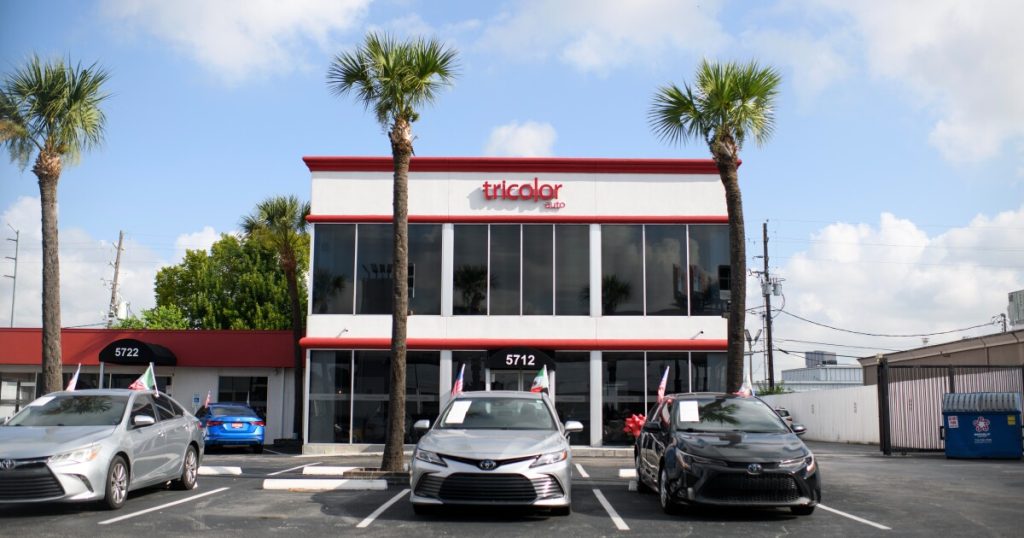
- Key insight: Tricolor CEO Daniel Chu, COO David Goodgame were arrested Tuesday for allegedly defrauding nine banks and financial institutions. The auto lender’s CFO Jerome Kollar and Senior Director of Finance Ameryn Seibold pled guilty.
- What’s at stake: The auto lender allegedly defrauded almost $1 billion from lenders, according to the Department of Justice.
- Forward look: Experts say it offers lessons on how to head off the damage from similar schemes in the future.
The other shoe has finally dropped for Tricolor Holdings Chief Executive Daniel Chu and the subprime auto lender’s other top executives following the company’s abrupt bankruptcy filing, according to an
Processing Content
Chu and Chief Operating Officer David Goodgame were arrested Tuesday in connection with an alleged multi-year fraud scheme that defrauded nine banks and alternative financiers of $923 million.
The indictment includes new details of how the banks were duped, and experts say it offers lessons on how to head off the damage from similar schemes in the future.
Chu is accused of operating a continuing financial crimes enterprise, along with three other bank and wire fraud charges. Goodgame was indicted on three charges related to bank and wire fraud.
Tricolor’s Chief Financial Officer Jerome Kollar and Senior Director of Finance Ameryn Seibold pled guilty to seven charges, including bank and wire fraud, securities fraud and destruction of records, and are cooperating with the government.
“These four executives allegedly conspired to defraud lenders based on bogus collateral,” said FBI Assistant Director in Charge Christopher G. Raia, in a statement. “The defendants’ alleged manipulation not only ripped off multiple banks but also violated the integrity of our credit markets.”
The nine banks and financial institutions that were affected by the fraud were not specifically named in the indictment, but at least five banks have previously said they would charge off loans made to Tricolor.
Representatives from
According to the indictment, the fraud at Tricolor started as early as 2018. The company allegedly double-pledged collateral to multiple lenders, which allowed it to borrow against the same asset multiple times.
The company had inventory lines of credit collateralized by used cars that it used to finance the purchase of those vehicles, as well as multiple credit lines that were collateralized by car loans that would eventually be sold to investors as bonds.
Tricolor also allegedly manipulated loan data, commonly referred to as borrowing base, to show delinquent loans as current, in order to comply with lender requirements, and it created records showing fake customer payments.
Chu allegedly paid out to himself more than $19 million in salary and bonuses between August 2023 and August 2025.
The fraud unraveled in August, when one lender described as a New York-based junior mezzanine lender began talking with another lender described as a U.S. bank about an unfinished audit of Tricolor’s borrowing bases that had begun around February. The junior mezzanine lender noticed that accounts that were reported as current did not show a corresponding reduction in outstanding principal balances.
Simply put, no payments were recorded, even though accounts were marked as current.
“The following day, on or about August 18, 2025, the Tricolor executives, including Daniel Chu and David Goodgame, the defendants, Kollar, and Executive-1, continued to discuss how to conceal the fraud,” the indictment alleges.
“During the call, Chu described how Lender-6 had identified, among other things, ‘$63 million of loans that have not had a payment in 180 days that are marked as current.’ Chu complained that he did not understand how Seibold could ‘be doing this and not thinking that the balance has to reduce,’ saying it was ‘the stupidest fucking thing [he had] ever heard,'” the indictment said.
It’s surprising that a fraud of this magnitude was not caught earlier by auditors, Bruce Newmark, president of the consultancy firm Fimanco, told American Banker on Wednesday.
The fraud likely flew under the radar for so long because auditors “were only looking at their own borrowing base. They were not looking at the other borrowing bases and tying them off,” Newmark said.
“Now that may be said to be the way the industry runs, and that might have been good enough in the past. A lesson here is that if you have a borrower that has multiple borrowing bases, somebody has to tie off the borrowing bases to make sure that the composite of the borrowing bases tie to the financial statement and then tie to the bank accounts,” Newmark said.
Banks likely need to reassess their auditing practices to prevent similar instances of double-pledged assets.
“It’s a failure of imagination at the very least — to be as kind as you could be — to understand how you would do this fraud,” Newmark said. “But the point at which you started having questions, the depth of the analysis had to go deeper, and certainly compare the borrowing base report to the system of record. Even on a spot check — pick all accounts ending in three and seven — you’re probably going to snag some unless you’re super unlucky.”
The alleged efforts by Chu and his coconspirators to conceal the fraud, included blaming loan discrepancies on fictitious deferment policies spurred by the Trump administration and blaming the banks for ignoring red flags in order to receive a favorable settlement agreement.
Tricolor Auto was a vertically integrated subprime automotive retail and finance company founded in 2007 that specialized in selling cars to thin- and no-file Hispanic customers using artificial intelligence-powered lending. It was one of the only subprime auto lenders designated as a community development financial institution by the U.S. Department of Treasury, and operated 65 automotive dealerships in Texas, California, Nevada, New Mexico, Arizona and Illinois.
The company had over 1,500 employees, and generated over $1 billion revenue, according to the Justice Department.
When the company filed for Chapter 7 bankruptcy in September, it had over 60,000 outstanding auto loans. It sold $217 million of bonds backed by loans on the asset-backed securities market in June.