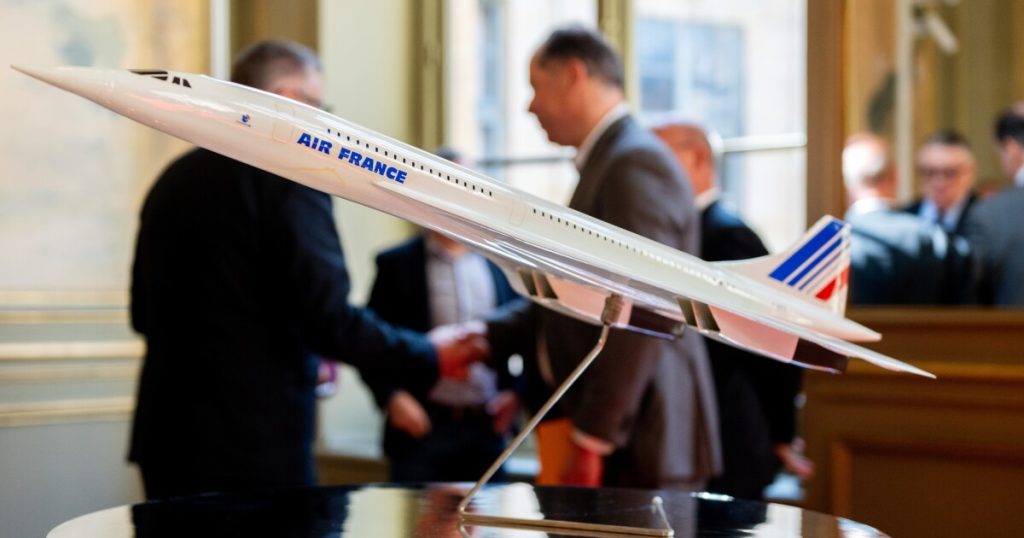
The supersonic Concorde was one of aerospace technology’s greatest achievements. However, its ultimate commercial failure should be a lesson for those pushing AI into banking. Advanced technologies often develop faster than consumers’ ability to benefit from them, warns Ken Thomas.
Benjamin Girette/Bloomberg
Good afternoon. This is your captain. We’ve reached our cruising altitude of 60,000 feet traveling at Mach-2 speed of just over 1,000 mph. Please sit back and enjoy your flight.
When I first heard about the supersonic Concorde jet in 1969 upon graduating from college, I realized that technology would define the future, and I must keep up with it as much as possible.
Likeartificial intelligence, hearing about technology means little until you actually experience its benefits. My weekly U.S. Air flights between Miami and Philadelphia during years of teaching at Wharton eventually earned the 250,000 miles my wife and I needed to fly the Concorde in 1998. The $25,000 round-trip fare, about $50,000 today, was otherwise prohibitive. We flew British Airways, or BA, from JFK to London and Air France back from Paris.
Unlike the jumbo jets I usually flew, the Concorde carried only 100 people and was very small inside, a sleek narrow tube. NBA players and NFL linemen would have been uncomfortable.
Thefive-star service, complete with china, silverware and multilingual attendants, was so extensive that I couldn’t get any work done. It seemed there were more flight attendants and crew than passengers on the flight to Heathrow.
The normal seven-hour flight was finished in just three, effectively in “no time” considering the time-zone difference. I learned that return flights from Europe were much fuller, since the time difference allowed businesspeople to save a day, making the sky-high fare easier to justify.
Being pre-9/11, the attendants allowed me to visit the cockpit during both flights. The BA pilots proudly emphasized Concorde was a U.K. creation with Rolls Royce engines. However, the Air France pilots insisted it was unmistakably French, “which is why we put an ‘e’ at the end of the name.” Actually, it was a joint French/U.K. heavily government subsidized project, reportedly meant to demonstrate that the U.S. and Soviet Union weren’t the only players in the Cold War’saerospace race.
The attendants alerted us as we accelerated from Mach 1 to Mach 2, though I hardly noticed the difference apart from watching the in-flight monitors. I did, however, appreciate flying close to the sun at 60,000 feet, when a flight attendant pressed a sheet of paper against the small window showing the curvature of the Earth.
The passengers were likely among the wealthiest on the planet. Attendants handed out expensive souvenirs like silver pens and flasks. When I asked for extras for my two sons, they simply smiled and said, “Wait until we deplane.” As the last one off, I was amazed that the uber-rich left these untouched keepsakes on their seats, at which point the attendants said, “Take whatever you’d like.”
A quarter century later, I’m still amazed by how fast technology advances, especially AI, and I think about several Concorde lessons applicable in banking today.
First, high tech doesn’t always mean high profit. Although an aerospace marvel, the Concorde was acommercial failure. Besides the high cost of fuel driving relatively inefficient jet engines with specialized maintenance requirements, fares were prohibitive for business travelers. Only 14 aircraft entered commercial service in 1973, and the entire fleet was shut down in 2003. I pay $20 monthly for ChatGPT, but there’s no way I am paying $200 monthly for the Mach-2 version. Yes, there are several free online AI tools, but not everyone can afford $200 or even $20 monthly. Dazzling technology is no guarantee of broad adoption or financial success.
Second, high tech often brings big problems, what economists call “externalities,” the negative or socially costly side effects. The global aviation infrastructure is built around subsonic jets. Concorde’s sonic boom restricted overland flights, and noise pollution created major airport challenges. AI requires a supersonic computational and energy ecosystem with rapidly evolving privacy, cybersecurity and otherpotential regulations. And, as we know in banking, even the greatest innovations ultimately bow to regulations.
Third, even the highest ofhigh-tech advancements can never anticipate every possible problem or random event, especiallywhen humans are involved. A negligently installed 10-pound metal strip fell from a departing Continental jet in Paris in 2000. The Concorde taking off behind it struck the debris, leading to acrash that killed more than 100 people. The disaster shattered public confidence, grounded the fleet and helped set the stage for the Concorde’s 2003 retirement. AI holds enormous promise, but human error can still ground the most advanced innovation.
Fourth, avoid the “Concorde Fallacy,” pouring valuable resources into a project destined to fail, also known as “throwing good money after bad.” High tech must have high acceptability and high usage on a broad commercial scale rather than being a niche product for the uber-rich. Flying at over 1,000 mph in the equivalent of a Bentley with world-class service was a bucket list experience, but realistically only available to elite one-percenters or those with million-mile airline accounts. Everyone wants the buzz of being on AI’s cutting edge, but bankers need to know exactly how it saves or makes money. Prestige without profitability is like risk without reward.
Fifth, never forget what I call the “Dilbert Disconnect” from the classic cartoon series wherebrilliant engineers put down marketing and other colleagues they deem inferior. Even the largest, fastest, and smartest invention, whether a Concorde or new AI-inspired banking product, will be a commercial failure without a strong marketing plan and effective managerial implementation. I often see the Dilbert Disconnect when a bank’s finance team carries an air of superiority over marketing, compliance and other essential departments. A Wharton Ph.D. in finance without training in marketing or compliance belongs in a classroom not a boardroom.
Sixth, when the government spends billions on a project, the benefits should flow to all taxpayers, not just big companies and the superrich. AI wasprivately developed but has the potential to benefit everyone, including small businesses and low- and moderate-income people. Any government role in supporting or promoting AI must be mindful of the broader public interest. Banks should likewise consider their entire community in any AI initiatives.
Our finance blog is your go-to resource for expert financial advice, covering everything from personal budgeting and saving strategies to smart investing and market analysis. Stay updated with the latest trends, tips, and insights to help you make informed decisions and achieve financial success.